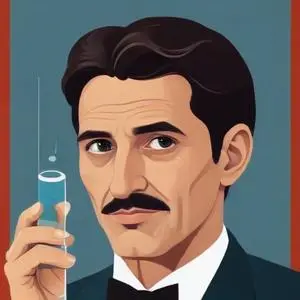
Luis Federico Leloir: The Nobel Laureate Who Unraveled the Secrets of Carbohydrate Metabolism
Unveiling the Metabolic Pathways of Life
Luis Federico Leloir, an Argentine physician and biochemist, etched his name in the annals of scientific history by discovering the metabolic pathways of carbohydrate synthesis and conversion into energy in the human body. This groundbreaking discovery earned him the prestigious Nobel Prize in Chemistry in 1970.
Early Life and Education
Born on September 6, 1906, in Paris, France, Leloir's life was marked by a series of fortunate events that steered him towards a career in medicine and science. After his father's untimely death, his mother, Hortensia Aguirre de Leloir, returned to Argentina with her newborn son. Growing up in a family of eight siblings on their extensive property, El Tuy, Leloir developed a fascination with natural phenomena and the connections between science and biology. He pursued his education at Escuela General San Martín, Colegio Lacordaire, and briefly at Beaumont College in England.
Research and Discovery
Leloir's research focus shifted to biochemistry during his time at the University of Buenos Aires, where he earned his medical degree. He went on to work under the guidance of
Bernardo Houssay, a renowned physiologist, and later established his own research group, Fundación Instituto Campomar. It was here that he made his Nobel Prize-winning discovery, unraveling the mysteries of sugar nucleotides and carbohydrate metabolism. His work had a profound impact on the understanding and treatment of congenital diseases, such as galactosemia.
Legacy and Impact
Leloir's contributions to science extend far beyond his Nobel Prize. His research has led to significant advancements in the fields of biochemistry, medicine, and biology. His work has also inspired generations of scientists and researchers, fostering a deeper understanding of the intricate mechanisms that govern human physiology. Today, his legacy continues to influence modern medicine, with his discoveries remaining a cornerstone of biochemical research.
Awards and Honors
- Nobel Prize in Chemistry (1970)
- Twice awarded the National Prize of Sciences (1943 and 1950)
- Honorary doctorates from universities in Argentina, Uruguay, and Peru
Personal Life and Later Years
Leloir's personal life was marked by a strong sense of humility and dedication to his work. He remained the director of Fundación Instituto Campomar until his death on December 2, 1987. He is buried in La Recoleta Cemetery, Buenos Aires, a testament to his enduring legacy in the city he called home.
FAQ
What are the key contributions of Luis Federico Leloir to biochemistry?
Luis Federico Leloir made significant contributions to biochemistry, including the discovery of the enzyme uridine diphosphate glucose, which led to a deeper understanding of carbohydrate metabolism and earned him the Nobel Prize in Chemistry in 1970. Leloirs work also paved the way for further research in glycogen synthesis and the diagnosis of glycogen storage diseases.
What is the significance of Leloirs discovery of uridine diphosphate glucose?
The discovery of uridine diphosphate glucose by Leloir has far-reaching implications in understanding metabolic pathways, particularly in glycogen synthesis and degradation. This discovery has also led to the development of diagnostic tools for glycogen storage diseases and has applications in industries such as pharmaceuticals and biotechnology.
What were the early life and education of Luis Federico Leloir like?
Luis Federico Leloir was born in Paris, France, in 1906 to French-Argentinian parents. He earned his medical degree from the University of Buenos Aires and later pursued advanced studies in biochemistry at the University of Cambridge, where he earned his Ph.D. in 1936.
What is the legacy of Luis Federico Leloir in Argentine science?
Leloir is considered a pioneer in Argentine science, having made significant contributions to the field of biochemistry. He founded the Institute of Biochemical Research in Buenos Aires, which has become a hub for scientific research in Argentina. Leloirs work has inspired generations of scientists in Argentina and beyond.
What are some notable awards and honors received by Luis Federico Leloir?
In addition to the Nobel Prize in Chemistry in 1970, Leloir received several notable awards and honors, including the Copley Medal from the Royal Society, the National Order of Merit from the Government of Argentina, and the Bernardo Houssay Award from the Argentine government.