


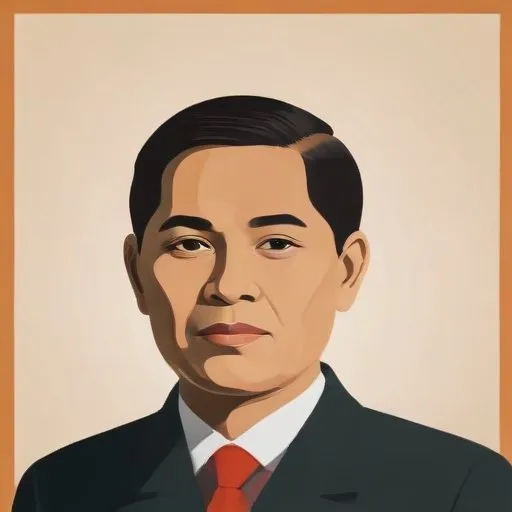
A prominent Burmese politician who served as the Prime Minister of British Burma from 1946 to 1947, playing a key role in the country's transition to independence.
Mahn Ba Khaing, a Karen politician, is remembered as a national martyr in Burma (now Myanmar) for his selfless service to the country. He served as the Minister of Industry and Labour in the pre-independence government and was assassinated alongside Prime Minister Aung San in 1947.
Born on 26 October 1903, in Yontalin Village, Hinthada Township, Ayeyarwady Region, Mahn Ba Khaing was the fifth son of Mahn Pe Kone, the village head, and Daw Pu. He received his education at the American Baptist Missionary School in Hinthada before leaving in 1920.
In 1937, Mahn Ba Khaing was elected as a parliamentarian for the northern Pathein region, marking the beginning of his political career. He went on to serve as the chairman of the Karen Youth Organisation, demonstrating his commitment to the welfare of the Karen people.
In 1946, when the Aung San-led interim government was formed, Mahn Ba Khaing was appointed as the Minister of Industry and Labour. This position allowed him to champion the cause of industrial development and labour rights in Burma.
On 19 July 1947, Mahn Ba Khaing's life was tragically cut short when he was assassinated, alongside Prime Minister Aung San and eight others, in the Minister's Building in Yangon (now the Secretariat Yangon). This event sent shockwaves throughout the nation and cemented Mahn Ba Khaing's status as a national martyr.
Mahn Ba Khaing's legacy is one of selfless service and devotion to his country. He is remembered as a champion of the Karen people and a pioneer in the struggle for Burma's independence. His grandson, Mahn Win Khaing Than, went on to become the acting Vice President of Myanmar, continuing his grandfather's legacy of public service.
Through his untimely demise, Mahn Ba Khaing's sacrifice will always be remembered as a beacon of hope and inspiration for future generations of Burmese leaders.
81 Years Old
A democracy icon and human rights activist, she led the fight against Myanmar's military rule and was awarded the Nobel Peace Prize in 1991.
81 Years Old
A former general who led Myanmar's transition from military rule to democracy, known for his reforms and release of political prisoners.
93 Years Old
A Burmese general and politician who served as the Prime Minister of Burma from 1992 to 2011, known for his authoritarian rule and human rights abuses.
Born in 1910
A Burmese army general and politician who ruled the country with an iron fist, implementing isolationist and nationalist policies that led to economic stagnation and human rights abuses.
Born in 1893
A Burmese lawyer and politician who served as Prime Minister of Burma, leading the country to independence from British colonial rule and playing a key role in shaping its early years. He's also known for his efforts to promote national unity and reconciliation.
Born in 1907
First Prime Minister of Burma, leading the country to independence from British colonial rule and establishing a democratic government. He's also known for his efforts to promote Buddhism and national unity.
Born in 1909
A Burmese educator and diplomat who served as the 3rd United Nations Secretary-General, mediating international conflicts and promoting global cooperation. He's known for his quiet diplomacy and leadership during the Cold War era.
