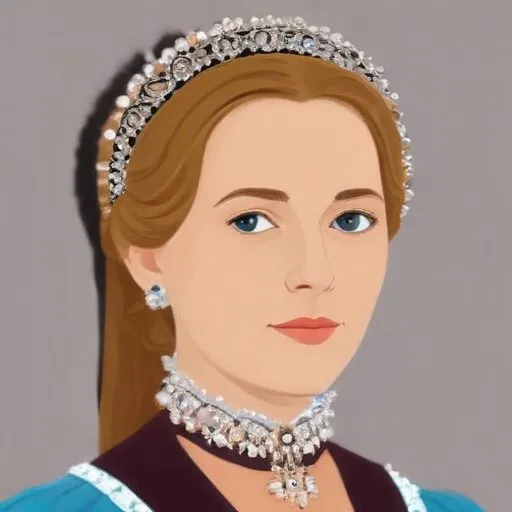
Maria Anna of Austria: The Austrian Archduchess and Queen of Portugal
A Regent of Distinction
Maria Anna of Austria is best known for her tenure as the regent of Portugal from 1742 to 1750, a period marked by her exemplary leadership and administrative prowess. As the wife of King John V of Portugal, Maria Anna played a crucial role in maintaining the stability of the Portuguese monarchy during a time of great turmoil.
Early Life and Background
Born on September 7, 1683, Maria Anna was the eleventh child and seventh daughter of
Leopold I, Holy Roman Emperor, and Eleonore Magdalene of Neuburg. Her family's illustrious heritage was marked by a long history of European monarchies, with two of her brothers, Joseph and Charles, later becoming emperors.
Marriage and Life as Queen Consort
On October 27, 1708, Maria Anna married John V, King of Portugal, in a union designed to strengthen the alliance between Austria and Portugal against France and Spain during the War of Spanish Succession. As queen consort, Maria Anna brought a sense of Austrian grandeur to the Portuguese court, introducing customs and traditions that would shape the country's nobility for generations to come.
Reforms and Legacy
Maria Anna's greatest impact on the Portuguese court was the introduction of segregation between men and women, as well as between servants and masters. This reform, though controversial, helped to establish a clear social hierarchy and solidified the queen's position as a leader. Her love of grand festivities and opulent parties also left an indelible mark on the Portuguese nobility, with her legendary soirees often lasting for days.
Regency and Later Life
In 1742, following her husband's stroke and partial paralysis, Maria Anna assumed the role of regent, skillfully guiding the country through a period of great uncertainty. Upon John V's death on July 31, 1750, their eldest son,
Joseph I of Portugal, succeeded him, and Maria Anna retired from public life. She passed away on August 14, 1754, at the Belém Palace, and was buried in Lisbon, with her heart later being interred in the Imperial Crypt in Vienna.
Issue and Family
Maria Anna and King John V had six children, four of whom survived infancy. Their children included:
- Barbara of Portugal (1711-1758), later Queen of Spain
- Pedro of Portugal (1712-1714)
- Joseph I of Portugal (1714-1777), later King of Portugal
- Charles of Portugal (1716-1736)
- Peter III of Portugal (1717-1786), later King of Portugal
- Alexander of Portugal (1723-1728)
Historical Context and Legacy
Maria Anna of Austria's life and reign are set against the backdrop of European monarchical politics, with her family's influence stretching across the continent. Her legacy as a regent and queen consort is one of administrative acumen, cultural refinement, and a deep understanding of the intricate balance of power that defined early modern Europe. As an Austrian archduchess and Queen of Portugal, Maria Anna's life serves as a testament to the enduring power of women in leadership and their capacity to shape the course of history.
FAQ
What was Maria Anna of Austrias role in the Imperial Austrian court?
Maria Anna of Austria played a significant role in the Imperial Austrian court, serving as a lady-in-waiting to Empress Maria Theresa and later as the Governess of the Archduchesses.
How did Maria Anna of Austria contribute to the education of the Archduchesses?
Maria Anna of Austria contributed to the education of the Archduchesses by serving as their governess and ensuring they received a thorough education in languages, literature, and music.
What was Maria Anna of Austrias relationship like with Empress Maria Theresa?
Maria Anna of Austrias relationship with Empress Maria Theresa was one of close friendship and loyalty, as she served as a trusted lady-in-waiting and confidante to the Empress.
How did Maria Anna of Austria impact the development of Austrian culture?
Maria Anna of Austria impacted the development of Austrian culture by promoting the arts, particularly music, and supporting the work of prominent composers, such as Wolfgang Amadeus Mozart.
What was Maria Anna of Austrias legacy in Austrian history?
Maria Anna of Austrias legacy in Austrian history is that of a dedicated and loyal member of the Imperial Austrian court, who played a significant role in shaping the education and cultural development of the Archduchesses.