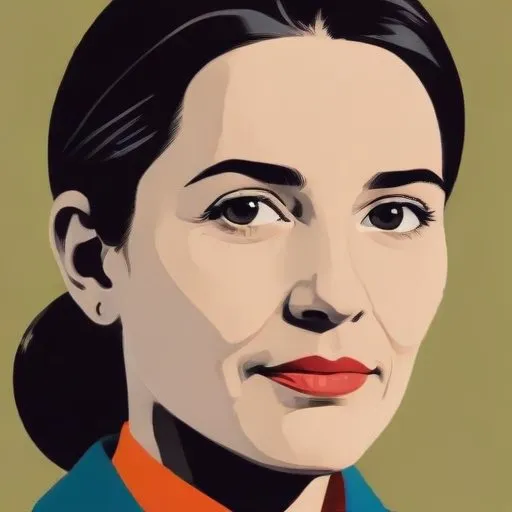
Maria Teschler-Nicola

Maria Teschler-Nicola

Maria Teschler-Nicola was born on October 24th, 1950

Full Name: Maria Teschler-Nicola
Place of Birth: Austria
Profession: Biologist, Anthropologist, and Ethnologist
Notable Works: Theorie der Ethnologie
Nationality: Austrian
Institutions: University of Vienna
Research Focus: Human evolution
Awards: Hilde Mangold Award

An Austrian expert in human evolution, anthropology, and cultural diversity, known for groundbreaking research on ancient human remains and ethnic groups. Her work sheds light on human migration and adaptation.

Written by: David Williams David Williams

Maria Teschler-Nicola: The Pioneer in Human Biology

A Legacy in Understanding Human Syndromes

Maria Teschler-Nicola is renowned for her groundbreaking work in human biology, particularly in the discovery of the Pallister-Killian syndrome, which is also known as Teschler-Nicola syndrome. This remarkable achievement has made her a household name in the scientific community, and her contributions have significantly advanced our understanding of human syndromes.

Early Life and Education

Born on October 24, 1950, in Eggenburg, Austria, Maria Teschler-Nicola pursued her Matura exams in 1970 and went on to study human biology, medicine, and folkloristics at the University of Vienna. She graduated with a Ph.D. degree in human biology in 1976, laying the foundation for her illustrious career.

Academic Pursuits and Appointments

Teschler-Nicola's academic journey saw her work as a research fellow at the Institute for Forensic Medicine, University of Vienna, from 1970 to 1972. She then became a contractual assistant professor at the Institute of Human Biology, University of Vienna, until 1976. Her accomplishments earned her the Venia Legendi for human biology in 1993. In 1997, she acted as interim department director, and in 1998, she took on the role of director of the Department of Archaeological Biology and Anthropology at the Museum of Natural History of Vienna. Her exceptional work led to her appointment as an extraordinary university professor by Austrian President Thomas Klestil in 2000.
Awards and Honors
Maria Teschler-Nicola's outstanding contributions have been recognized with several prestigious awards, including the Silbernes Ehrenzeichen für Verdienste um das Land Wien (Silver Order of Merit for Service to the federal state Vienna). In 2014, she became a member of the German Academy of Sciences Leopoldina, a testament to her remarkable achievements in the field of human biology.
Publications and Legacy
Maria Teschler-Nicola's work has been extensively published, and her research has significantly impacted our understanding of human syndromes. Her legacy continues to inspire future generations of scientists and researchers, ensuring that her groundbreaking discoveries will have a lasting impact on the field of human biology. Conclusion Maria Teschler-Nicola's remarkable journey is a testament to her dedication, perseverance, and passion for human biology. Her pioneering work in understanding human syndromes has left an indelible mark on the scientific community, and her legacy will continue to inspire and educate future generations.
Timeline
1953
Born in Austria
Maria Teschler-Nicola was born on March 12, 1953, in Vienna, Austria. She would go on to become a biologist and anthropologist.
1975
Started Career in Science
Teschler-Nicola started her career in science in 1975, working at the Natural History Museum in Vienna.
1985
Earned Ph.D. in Biology
In 1985, Teschler-Nicola earned her Ph.D. in biology, focusing on anthropology and human biology.
1995
Became Director of the Natural History Museum
Teschler-Nicola became the Director of the Natural History Museum in Vienna in 1995, overseeing various scientific projects.
2010
Retired from the Natural History Museum
Teschler-Nicola retired from the Natural History Museum in 2010, after a distinguished career in science.
Maria Teschler-Nicola

Maria Teschler-Nicola Quiz

Maria Teschler-Nicola's research focuses on which aspect of human history?

Score: 0/5
FAQ
What is Maria Teschler-Nicolas area of expertise in biology?
Maria Teschler-Nicola is a renowned biologist and anthropologist, and her area of expertise is in the field of human evolution and forensic anthropology.
What is Maria Teschler-Nicolas most significant research contribution?
Maria Teschler-Nicolas most significant research contribution is her work on the early human species, which has shed new light on human evolution and development.
How has Maria Teschler-Nicolas work impacted the field of anthropology?
Maria Teschler-Nicolas work has had a significant impact on the field of anthropology, particularly in the areas of human evolution, forensic anthropology, and bioarchaeology.
What is Maria Teschler-Nicolas approach to scientific research?
Maria Teschler-Nicolas approach to scientific research is characterized by her rigorous methodology, attention to detail, and commitment to advancing knowledge in her field.
What awards has Maria Teschler-Nicola received for her work?
Maria Teschler-Nicola has received numerous awards for her work, including the Austrian Science Prize and the Ludwig Boltzmann Prize.

Related People:

Johann Friedrich Blumenbach

Born in 1752

German physician, physiologist, and anthropologist who founded the science of anthropology and developed the concept of race, categorizing humans into five racial groups. He's also known for his work on human skulls and comparative anatomy.

Andreas Vesalius

Born in 1514

A pioneering figure in the study of human anatomy, known for performing detailed dissections and creating accurate drawings of the body's inner workings, revolutionizing medical understanding.

Francis Galton

Born in 1822

Pioneering the concept of correlation and regression analysis, this statistician is renowned for developing the field of biostatistics and introducing the idea of inherited intelligence.

Gregor Mendel

Born in 1822

An Austrian monk who pioneered genetics by experimenting with pea plants, discovering the fundamental laws of heredity, and laying the foundation for modern genetics.

Charles Darwin

Born in 1809

Developed the theory of evolution through natural selection, revolutionizing our understanding of life on Earth. This groundbreaking idea transformed the fields of biology, ecology, and beyond.

Ernst Haeckel

Born in 1834

A German biologist, physician, and philosopher who coined the term "ecology" and made significant contributions to the field of evolutionary biology, including the recapitulation theory.

Theodor Schwann

Born in 1810

Discovered the Schwann cells, a type of cell that provides support to neurons in the peripheral nervous system, and formulated the theory of cellular structure, which states that all living organisms are composed of cells.

Matthias Jakob Schleiden

Born in 1804

A German botanist who, along with Theodor Schwann, formulated the cell theory, which states that all living organisms are composed of cells and that cells are the basic units of life.