


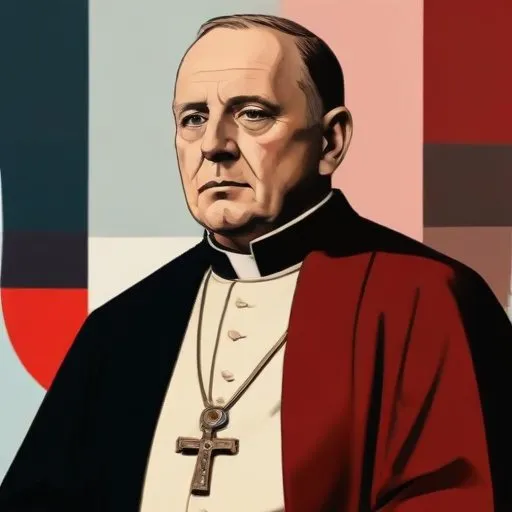
A German priest and theologian who played a crucial role in shaping the Lutheran Reformation, contributing to the development of Protestant theology.
Martin Adolf Bormann, a German theologian and former Catholic priest, was born into a world of controversy, being the son of Martin Bormann, the head of the Nazi Party Chancellery and private secretary to Adolf Hitler. His life was forever marked by the dark shadow of his father's legacy, yet he chose to forge a different path, one of faith and redemption.
Born on April 14, 1930, in Grünwald, Bavaria, Martin Adolf Bormann was the eldest of ten children. His parents, Martin Bormann and Gerda Buch, raised him in an environment that was deeply entrenched in Nazi ideology. Adolf Hitler, his godfather, played a significant role in his early life, and it was no surprise that the young Martin became an ardent young Nazi.
In 1945, with the war drawing to a close, Martin Adolf Bormann found himself stranded in Salzburg, where he took on a false identity and sought refuge with a Catholic farmer, Nikolaus Hohenwarter. It was during this period that he began to question his Nazi upbringing, and eventually, he converted to Catholicism. This dramatic shift in his beliefs and values would shape the course of his life.
Martin Adolf Bormann went on to pursue a career in theology, becoming a Catholic priest in 1958. He dedicated his life to spreading the message of faith and redemption, working tirelessly to make amends for the wrongs committed by his family. His theological contributions centered around the concept of redemption, and he became known for his thought-provoking writings on the subject.
Martin Adolf Bormann's life serves as a testament to the power of forgiveness and redemption. Despite being born into a family synonymous with evil, he chose to forge a different path, one that was guided by faith and compassion. His legacy continues to inspire those who seek to make amends for past wrongs, and his work remains a beacon of hope for a better tomorrow.
Martin Adolf Bormann's theological pursuits focused on the concept of redemption, particularly in the context of his own family's history. He believed that individuals had the power to choose their own path, regardless of their upbringing or circumstances. His work emphasized the importance of forgiveness, compassion, and making amends for past wrongs.
Martin Adolf Bormann's life and work serve as a powerful reminder of the importance of redemption and forgiveness. His story has inspired countless individuals to re-examine their own beliefs and values, and to strive for a better tomorrow.
99 Years Old
The first pope to resign in nearly 600 years, he's known for his conservative views and efforts to strengthen the Catholic Church's traditional teachings. He's also a prolific writer and theologian.
Born in 1920
Leader of the Catholic Church from 1978 to 2005, known for helping to end communism in Poland and being a charismatic advocate for human rights and social justice.
Born in 1904
A German priest and theologian who sought to reconcile Catholicism with modern philosophy, exploring the intersection of faith and reason. His work greatly influenced 20th-century Catholic theology.
98 Years Old
A prominent Catholic theologian and prolific author, known for his progressive views on Christianity and criticism of the Catholic Church's authority. He wrote extensively on theology, ethics, and politics.
Born in 1906
A German pastor and theologian who resisted the Nazi regime, writing influential books on faith and ethics, and ultimately giving his life for his convictions.
Born in 1483
A German monk and priest who sparked the Protestant Reformation, challenging Catholic Church authority and shaping Western Christianity. He's famous for nailing 95 theses to a church door, sparking a religious revolution.
Born in 1550
The pope who condemned Galileo's heliocentric theory and established the Immaculate Conception as Catholic dogma, shaping the Church's stance on science and theology.
