


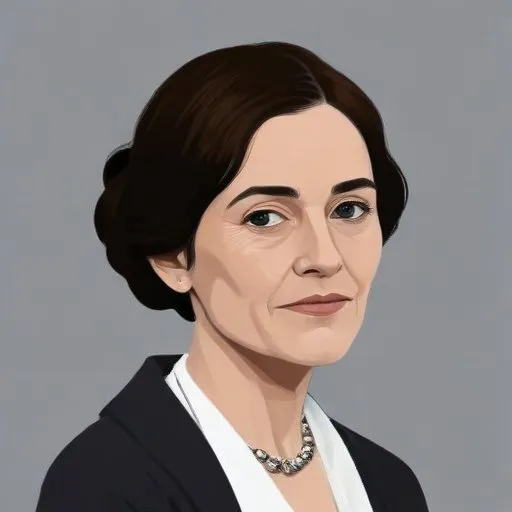
A Shropshire-born wordsmith, celebrated for her lyrical prose and poetry that vividly capture the English countryside and its people. Her works are treasured for their beauty and insight into rural life.
Mary Webb was a prominent English romance novelist and poet of the early 20th century, renowned for her works set in the picturesque Shropshire countryside, where she drew inspiration from the people and landscapes she knew intimately.
Her novels have been successfully adapted into films, with the most notable being the 1950 production of "Gone to Earth" by Michael Powell and Emeric Pressburger, and have even inspired parodies, such as Stella Gibbons' "Cold Comfort Farm" in 1932.
Mary Gladys Meredith was born on March 25, 1881, at Leighton Lodge in the Shropshire village of Leighton, where she was baptised at St Mary's parish church. Her father, George Edward Meredith, a private schoolteacher, instilled in her a love for literature and the local countryside, which would later influence her writing.
Her mother, Sarah Alice, was descended from a family related to the famous Scottish author and poet Sir Walter Scott. Mary spent her early years exploring the Shropshire countryside, developing a keen sense of observation and description that would later infuse her poetry and prose.
At the age of one, Mary moved with her parents to Much Wenlock, where they lived at The Grange outside the town. She was taught by her father and later sent to a finishing school for girls at Southport in 1895.
Mary adopted a vegetarian lifestyle from a young age, motivated by her strong feelings against animal slaughter. The family moved again to Stanton upon Hine Heath in 1896 and eventually settled in Meole Brace, now on the outskirts of Shrewsbury, in 1902.
It was during her time in Stanton that Mary began writing poems and articles for the local parish magazine. However, her life was not without challenges, as she developed symptoms of Graves' disease at the age of 20, a thyroid disorder that would affect her health throughout her life and contribute to her early demise.
Mary Webb's literary career was marked by a strong sense of empathy and observation, which she developed through her experiences and interactions with the people of Shropshire. Her novels often featured strong female characters and explored themes of love, nature, and the human condition.
Some of her notable works include "The Golden Arrow" (1916), "Gone to Earth" (1917), and "Precious Bane" (1924), which won the Prix Femina-Vie Heureuse award in 1926.
Mary Webb's writing style was characterized by her vivid descriptions of the Shropshire countryside and her ability to create strong, memorable characters. Her works have been praised for their lyricism and emotional depth, and have drawn comparisons to the works of Thomas Hardy and the Brontë sisters.
Her influence can be seen in the works of later authors, such as Stella Gibbons, who was inspired by Webb's writing style and themes. Mary Webb's legacy continues to be felt in the world of literature, and her works remain popular with readers to this day.
Mary Webb's life and works have left an indelible mark on the literary world. Her novels have been translated into numerous languages and continue to be widely read and studied.
Her legacy extends beyond the world of literature, as her works have also contributed to the preservation and promotion of Shropshire's cultural heritage. Mary Webb's love for the Shropshire countryside and its people has inspired generations of writers, artists, and conservationists.
Mary Webb's life was a testament to her love for literature, nature, and the people of Shropshire. Through her works, she has left behind a legacy that continues to inspire and captivate readers to this day.
As a novelist, poet, and observer of human nature, Mary Webb remains an important figure in the literary landscape of the early 20th century, and her contributions to literature and Shropshire's cultural heritage will not be forgotten.
Born in 1885
A pioneering writer of the early 20th century, known for exploring themes of human nature, relationships, and the clash between individual desire and societal expectations through novels like "Sons and Lovers" and "Lady Chatterley's Lover".
Born in 1879
This celebrated author crafted novels and plays that probed the human condition, exploring themes of social class, morality, and personal relationships, with a distinctive wit and insight. Their works continue to captivate audiences with their nuanced portrayals of English society during the early 20th century.
Born in 1882
A pioneering author of modernist literature, known for experimental novels and essays that explored the human experience, blurring the lines between reality and fiction.
Born in 1885
A pioneering modernist poet and critic who transformed 20th-century literature with innovative styles and provocative ideas, shaping the course of modern poetry.
Born in 1873
A pioneering modernist writer, credited with influencing 20th-century literature through experimental novels and poetry that explored the human condition. Known for his impressionistic style and complex characters.
Born in 1866
A visionary writer who pioneered the science fiction genre, crafting timeless classics like "The Time Machine" and "War of the Worlds" that continue to inspire and captivate audiences today.
Born in 1867
A prolific writer of novels and plays, known for his realistic portrayals of life in the Staffordshire Potteries and his influence on the development of modern English literature.
Born in 1867
A renowned English novelist and playwright, best known for his insightful portrayals of the British upper class and social commentary, particularly in his series "The Forsyte Saga".
