


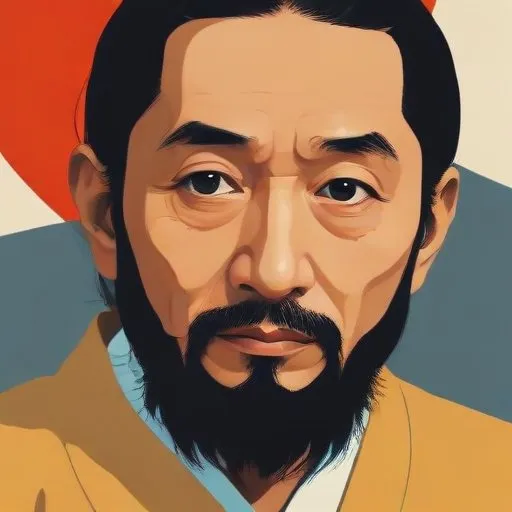
A pioneering scholar of Japanese thought, blending Eastern and Western philosophies to create a unique perspective on spirituality and culture. He's known for introducing Japanese philosophy to the West.
Masaharu Anesaki, a renowned Japanese intellectual and scholar, is credited with founding the field of religious studies in Japan. Through his vast and diverse body of work, he explored the realms of culture, literature, politics, and philosophy, earning him the esteemed title of "Father of Japanese Religious Studies."
Anesaki was born on July 25, 1873, in Kyoto, Japan, to a family of the Samurai class. His early education took place at the private Oriental School, where he studied English. He later attended the Third High School and eventually enrolled in the Tokyo Imperial University in 1893, majoring in philosophy.
In 1900, Anesaki embarked on a three-year journey to India and Europe, where he studied under esteemed scholars such as Deussen, Hermann Oldenberg, Gerbe, and Albrecht Weber in Germany, as well as Thomas William Rhys Davids in England. This experience not only broadened his knowledge but also shaped his perspective on diverse cultures and religions.
Anesaki's academic pursuits were instrumental in shaping the intellectual landscape of Japan. He was a prolific writer, producing works that encompassed a wide range of subjects, including culture, literature, and politics. His travelogue, Hanatsumi Nikki (Flowers of Italy), recounts his journey through Italy, tracing the steps of Saint Francis of Assisi.
As a visiting scholar at Harvard University from 1913 to 1915, Anesaki lectured on Japanese literature and life. These lectures later formed the basis of his seminal work, History of Japanese Religion. He was also instrumental in founding the University of Tokyo's library, which would become a hub for scholarly collections.
Anesaki's work was deeply rooted in his philosophical beliefs, which emphasized the importance of understanding and respect for diverse cultures and religions. His scholarship was characterized by a nuanced approach, recognizing the intricate relationships between religion, culture, and society.
Anesaki's contributions to the field of religious studies have had a lasting impact on modern Japanese society. His work has inspired generations of scholars, fostering a deeper understanding of Japan's cultural heritage and its place in the global community. As a testament to his legacy, he remains one of the most revered figures in Japanese intellectual history.
Anesaki's achievements were recognized through his membership in the International Committee on Intellectual Cooperation of the League of Nations. This esteemed position solidified his reputation as a leading intellectual of his time.
Through his remarkable life and work, Masaharu Anesaki has left an indelible mark on Japanese scholarship, inspiring future generations to engage with the rich cultural heritage of Japan.
Born in 1724
Developed influential philosophical frameworks, such as the Critique of Pure Reason, that shaped modern Western thought on ethics, morality, and human understanding.
Born in 1770
A German philosopher and academic who developed a comprehensive and systematic philosophy that emphasized the unity of all things and the dialectical process of thesis, antithesis, and synthesis. His ideas have had a profound impact on modern thought, influencing fields such as philosophy, politics, and art.
Born in 1889
A German philosopher and academic who explored the meaning of existence, time, and human existence, influencing 20th-century philosophy with his concept of "Being-in-the-world".
Born in 1905
Existentialist philosopher and playwright who argued that humans have complete freedom to choose their actions and create their own meaning in life, influencing modern thought on morality and individual responsibility.
Born in 1908
A pioneering feminist philosopher who wrote extensively on ethics, politics, and gender, famously arguing that "one is not born, but rather becomes, a woman."
Born in 1908
A French philosopher and academic who developed the concept of phenomenology, exploring the relationship between the self and the world, and is known for his work on perception, consciousness, and embodiment.
Born in 1883
A German-Swiss psychiatrist and philosopher who developed the concept of existentialism, emphasizing individual freedom and responsibility, and wrote extensively on philosophy, psychology, and politics. His work explored the human condition, morality, and the search for meaning.
