


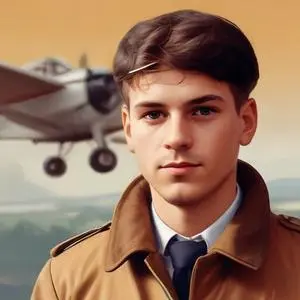
German aviator who landed a small plane in Moscow's Red Square in 1987, causing a major Cold War embarrassment for the Soviet Union. This daring stunt made headlines worldwide.
On May 28, 1987, Mathias Rust, a then 18-year-old amateur pilot, made history by landing his small Cessna plane on Bolshoy Moskvoretsky Bridge, next to Red Square in Moscow, without authorization. This daring stunt caught the world's attention and cemented Rust's place as a symbol of youthful courage and idealism.
Born on June 1, 1968, in Wedel, West Germany, Rust grew up with a passion for flying. He began taking flying lessons at the age of 14 and accumulated around 50 hours of flying experience by the time of his historic flight. On May 13, 1987, Rust rented a Reims Cessna F172P and set off from Uetersen Airport, near Hamburg, with the goal of creating an "imaginary bridge to the East."
Rust's flight took him from Helsinki, Finland, to Moscow, without being detected by Soviet air defenses. He landed on the bridge, near the Kremlin, and was immediately arrested. Rust claimed his intention was to reduce tension and suspicion between the two Cold War sides. However, the Soviet authorities were not amused, and Rust was sentenced to four years in a labor camp for violating border crossing and air traffic regulations.
Rust's flight had far-reaching consequences for the Soviet military and politics. The incident led to the dismissal of several high-ranking officials, including Minister of Defence Marshal of the USSR Sergei Sokolov and the Commander-in-Chief of the Soviet Air Defence Forces, Chief Marshal Alexander Koldunov. This, in turn, aided Mikhail Gorbachev in implementing his reforms, as he was able to remove opposition from military officials.
After serving 14 months in prison, Rust was pardoned by Andrei Gromyko, the Chairman of the Presidium of the Supreme Soviet, and released. Upon his return to Germany, Rust was hailed as a hero and a symbol of freedom. He went on to study psychology and philosophy, and has since led a private life, avoiding public attention.
Rust's flight is often seen as a symbol of the power of individual action and a testament to the human spirit. It has inspired countless stories, songs, and artworks, and continues to fascinate people to this day. Rust's courage and idealism have made him an enduring figure of the Cold War era.
Rust's story serves as a reminder that even the most seemingly impossible feats can be achieved with determination and courage. His legacy continues to inspire generations, and his name has become synonymous with bravery and daring.
95 Years Old
The last leader of the Soviet Union, who introduced reforms that led to the end of the Cold War and the collapse of communism, earning a Nobel Peace Prize. He's known for his policies of glasnost and perestroika, which transformed the Soviet Union and the world.
Born in 1911
The charismatic leader who championed conservative policies, helped end the Cold War, and is often credited with restoring American pride and optimism. He's also remembered for his folksy, actor-honed communication style.
Born in 1912
The last communist leader of East Germany, known for his rigid adherence to Soviet ideology and his role in constructing the Berlin Wall.
96 Years Old
The first unified Germany's leader, who oversaw the country's reunification after the Berlin Wall's fall, and is credited with creating a strong, stable economy.
Born in 1915
A prominent post-war German politician who served as Minister President of Bavaria and played a key role in shaping the country's conservative politics. He was also a strong advocate for European integration.
Born in 1924
The 41st President of the United States, a decorated war hero and skilled diplomat, led the country through the end of the Cold War and Gulf War. He's known for his foreign policy expertise and "kinder, gentler nation" vision.
Born in 1925
The first female Prime Minister of the United Kingdom, serving from 1979 to 1990, known for her conservative policies and leadership during the Falklands War.
Born in 1914
Leader of the Soviet Union from 1982 to 1984, known for attempting to reform the stagnant Soviet economy and crack down on corruption. Implemented policies to increase discipline and productivity.
