


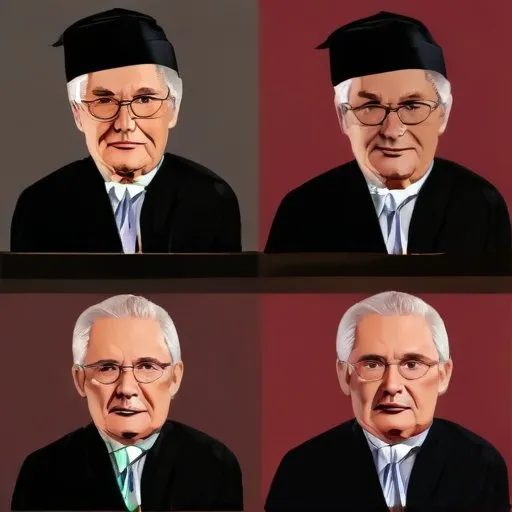
A 17th-century English lawyer who served as Lord Chief Justice of England, known for his strong advocacy of the common law and his role in shaping the English legal system.
Renowned for his seminal work, Historia Placitorum Coronæ, or The History of the Pleas of the Crown, Sir Matthew Hale was an erudite English barrister, judge, and jurist who left an indelible mark on the realm of law and jurisprudence.
Born on November 1, 1609, to a barrister father and his wife, Hale's early life was marked by tragedy when both his parents passed away by the time he was just five years old. He was then raised by his father's relative, a strict Puritan, who instilled in him a strong sense of faith and morality. This upbringing would later shape Hale's unwavering commitment to integrity and fairness in his professional life.
In 1626, Hale matriculated at Magdalen Hall, Oxford (now Hertford College), intending to become a priest. However, after a series of distractions, he was persuaded to pursue a career in law, following in his father's footsteps. He joined Lincoln's Inn in 1628 and was called to the Bar in 1636. As a barrister, Hale represented several prominent Royalist figures during the English Civil War, including Thomas Wentworth and William Laud.
Following the Declaration of Breda, Hale moved to consider Charles II's reinstatement as monarch, sparking the English Restoration. He later retired on February 20, 1676, after a bout of illness, and passed away on December 25, 1676.
Hale's commitment to integrity, fairness, and neutrality earned him a reputation as a trusted and respected figure in the tumultuous landscape of 17th-century England. His work continues to influence English criminal law and jurisprudence to this day.
Hale's strong Puritan upbringing instilled in him a strong sense of morality and faith, which guided his professional life and informed his approach to justice. His commitment to fairness and integrity remains a testament to his enduring legacy.
Sir Matthew Hale's life and work spanned a period of great turmoil and upheaval in English history, from the English Civil War to the Restoration. Despite the challenges he faced, Hale remained a beacon of integrity and fairness, earning him a lasting place in the annals of English legal history.
In conclusion, Sir Matthew Hale's remarkable life and contributions continue to inspire and inform the world of law and jurisprudence, cementing his status as one of the most notable figures of 17th-century England.
Born in 1599
Leader of the Parliamentarian forces during the English Civil War, who later ruled England, Scotland, and Ireland as a republican dictator, known for his military victories and radical reforms.
Born in 1630
The last monarch of the House of Stuart, restored to the throne after a republican Commonwealth, known for his lavish spending, mistresses, and the Great Fire of London. He ruled with a mix of absolutism and indulgence, shaping England's Restoration era.
Born in 1608
Wrote epic poems, including "Paradise Lost", that explored themes of morality, free will, and the human condition.
Born in 1632
A 17th-century thinker who laid the groundwork for modern democracy, arguing that governments derive their power from the people and that individuals have inherent rights to life, liberty, and property.
Born in 1588
A 17th-century philosopher who introduced the concept of social contract, arguing that people voluntarily give up some rights to a sovereign power in exchange for protection and stability. His ideas shaped modern political thought and the nature of government.
Born in 1552
A prominent figure in English law, he played a significant role in shaping the country's legal system and is remembered for his contributions to the development of common law.
Born in 1561
A 16th-17th century Renaissance figure who pioneered the scientific method and empiricism, and served as a prominent government official.
Born in 1584
A renowned 17th-century jurist and scholar who made significant contributions to the fields of law, history, and literature, earning him a reputation as one of the most learned men of his time.
