


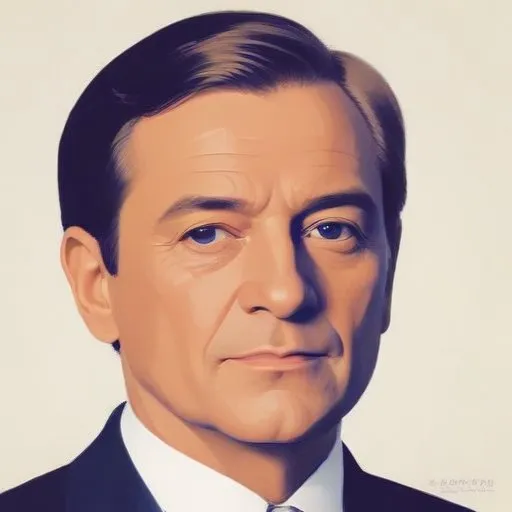
A French journalist and politician who served as Minister of Foreign and European Affairs, known for his key role in shaping post-war France's foreign policy and European integration. He was a strong advocate for a united Europe and played a crucial part in establishing the European Coal and Steel Community.
Maurice Schumann, a French politician, journalist, writer, and Second World War hero, is best known for his bravery and eloquence as the Minister of Foreign Affairs under Georges Pompidou from 1969 to 1973. During this period, he was the face of France, broadcasting news reports and commentaries into France on the BBC French Service, earning him the nickname "the voice of France."
Schumann was born on April 10, 1911, to an Alsatian Jewish father and a Roman Catholic mother. He studied at the Lyce Janson-de-Sailly and the Lycée Henri IV. In 1937, he converted to Catholicism, following in his mother's footsteps. This tumultuous beginning would set the stage for a life marked by resilience and courage.
During the Second World War, Schumann's voice became synonymous with hope and resistance. He broadcast news reports and commentaries into France on the BBC French Service over 1,000 times, inspiring the French people to persevere against the Nazi occupation. His words, filled with passion and conviction, earned him the respect and admiration of the French people, who came to rely on his broadcasts as a beacon of hope.
Schumann's political career was marked by his commitment to European unity and his Christian democratic values. As a member of the Popular Republican Movement, he played a crucial role in shaping France's foreign policy during the 1960s and 1970s. In 1969, he became the Minister of Foreign Affairs, a position he held until 1973.
One of Schumann's most significant contributions as Minister of Foreign Affairs was his role in shaping France's position on European unity. During a meeting of the foreign ministers of the European Community in 1969, he outlined France's conditions for Britain's entry into the community, emphasizing the need for agricultural finance reform. This stance reflected his commitment to a united Europe, but one that was predicated on fair and equitable trade practices.
Schumann's legacy extends far beyond his political accomplishments. He was a symbol of French resistance and resilience, a voice that inspired hope during a time of darkness. Through his broadcasts, he humanized the struggle against the Nazi occupation, giving voice to the struggles and aspirations of the French people.
Today, Schumann's legacy continues to inspire. His commitment to European unity, his bravery in the face of adversity, and his eloquence in the midst of turmoil continue to inspire generations of French citizens and Europeans alike.
"...and now we are reduced to the most atrocious fate: to be killed without killing back, to be killed by friends without being able to kill our enemies."
These words, spoken during the darkest days of the war, capture the essence of Schumann's spirit and his unwavering dedication to the French people. They serve as a testament to his courage, his conviction, and his unwavering commitment to the values of liberty, equality, and fraternity.
Maurice Schumann passed away on February 9, 1998, at the age of 86, leaving behind a legacy that continues to inspire and captivate. Through his words, his actions, and his unwavering commitment to the French people, Schumann etched his place in the annals of French history, earning his rightful place as "the voice of France."
Born in 1810
A renowned Romantic-era composer and influential music critic, known for his expressive and emotionally charged works, including symphonies, piano music, and art songs.
Born in 1876
Led post-war West Germany's reconstruction and served as a key figure in shaping the country's modern identity, earning him the title "Father of the Federal Republic."
Born in 1881
Italian journalist and politician who served as the 30th Prime Minister of Italy, leading the country's post-WWII reconstruction and European integration efforts. He's known for his key role in shaping modern Italy's politics and economy.
Born in 1899
A Belgian lawyer and politician who served as the 46th Prime Minister of Belgium, known for his key role in shaping the European Union and its institutions. He was a strong advocate for European integration and cooperation.
Born in 1901
First President of the European Commission, instrumental in shaping the EU's early development and integration, and a key figure in post-war European politics.
Born in 1888
A key architect of the European Union, credited with uniting a war-torn continent through economic cooperation and integration. His vision for a unified Europe has shaped modern politics and global relations.
Born in 1890
A French military leader who led the Free French Forces during WWII and later became President of France, known for his strong leadership and vision for a unified Europe.
Born in 1916
A French lawyer and politician who served as the 21st President of France, known for his socialist policies and role in shaping the European Union. He's also remembered for his controversial past and complex personality.
