


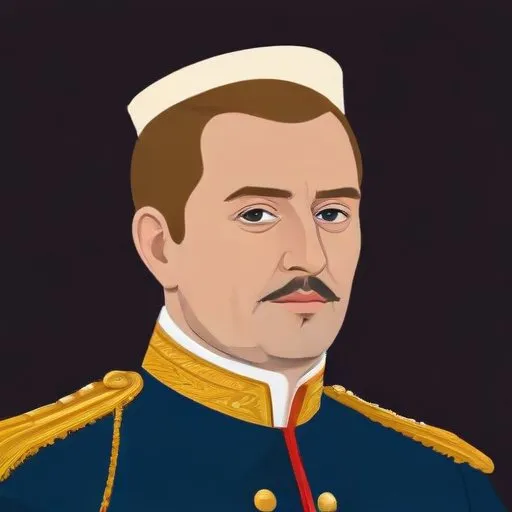
Elector of Bavaria who ruled from 1745 to 1777, known for his enlightened reforms, cultural achievements, and military successes, earning him the title "Father of the Country".
As the last of the Bavarian branch of the House of Wittelsbach, Maximilian III Joseph is renowned for his valiant efforts to maintain the sovereignty of Bavaria amidst the tumultuous landscape of 18th-century European politics. His tenure as Elector of Bavaria from 1745 to 1777 was marked by prudent decision-making, calculated alliances, and a deep understanding of the intricate web of power dynamics that defined the Holy Roman Empire.
Born on March 28, 1727, in Munich, Maximilian Joseph was the eldest son of Holy Roman Emperor Charles VII and his wife, Maria Amalia of Austria. Following his father's death in January 1745, the 18-year-old Maximilian inherited a country on the brink of invasion by Austrian armies. This precarious situation would shape his leadership style and inform his subsequent decisions as Elector of Bavaria.
The War of the Austrian Succession presented Maximilian Joseph with a daunting challenge: to defend Bavaria's sovereignty while avoiding the pitfalls of entanglement in the broader conflict. He vacillated between the Peace Party, led by his mother and Army Commander Friedrich Heinrich von Seckendorff, and the War Party, led by Foreign Minister General Ignaz Count of Törring and the French envoy Chavigny. Ultimately, he chose to abandon his father's imperial pretenses and negotiated the Treaty of Füssen with Maria Theresa in 1745, agreeing to support her husband, Grand Duke Francis II Stephen of Tuscany, in the upcoming imperial election.
In 1747, Maximilian married his first cousin, Maria Anna Sophia of Saxony, in a union that, unfortunately, remained childless. This personal circumstance would have far-reaching implications, as it would later contribute to the outbreak of the War of Bavarian Succession following his death in 1777.
During the Seven Years' War, Bavarian forces fought alongside the Habsburgs, but Maximilian Joseph's primary objective was to safeguard Bavarian autonomy. He deployed a small force of 4,000 men to join the Austrian army, aware that an overly strong Habsburg presence could compromise Bavaria's independence. In 1758-1759, he withdrew Bavarian auxiliary troops from Austrian service, demonstrating his commitment to maintaining a delicate balance of power.
Maximilian III Joseph's astute leadership and calculated diplomacy helped preserve Bavaria's sovereignty in the face of formidable external pressures. His death in 1777 triggered the War of Bavarian Succession, a conflict that would have significant consequences for European politics. Today, he is remembered as a shrewd and pragmatic leader who navigated the treacherous landscape of 18th-century politics with remarkable acumen.
Born in 1786
The King of Bavaria who commissioned the iconic Neuschwanstein Castle, a fairytale-like palace that inspired the Disney castle, and was a patron of the arts, supporting Richard Wagner's operas.
Born in 1756
King of Bavaria from 1806 to 1825, known for his liberal reforms and modernization of the country, earning him the title "Father of the Constitution".
Born in 1771
An Austrian field marshal who led the coalition forces to victory against Napoleon at the Battle of Leipzig, and later became Prime Minister of Austria.
Born in 1732
Austrian archbishop who was a patron of the arts, particularly music, and employed Wolfgang Amadeus Mozart as his court musician. He played a significant role in shaping Mozart's career.
Born in 1719
A renowned 18th-century musician, composer, and conductor, known for his influential violin instruction book and being the father of Wolfgang Amadeus Mozart.
