


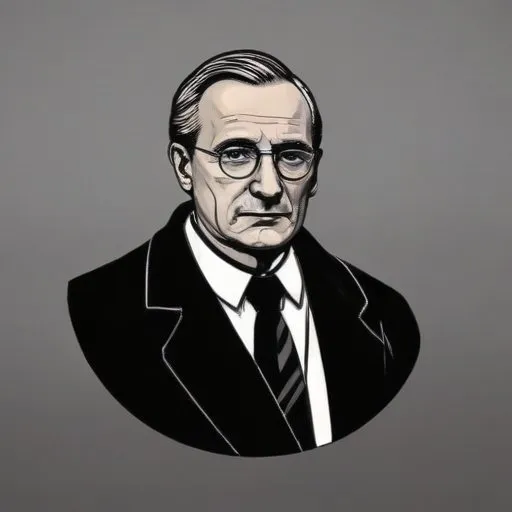
Developed the first Protestant hymnal and composed hymns that are still sung today, making significant contributions to the development of Lutheran liturgy and music.
Paul Luther, the son of the renowned German Protestant Reformer Martin Luther, made a name for himself as a skilled physician, medical chemist, and alchemist in 16th-century Europe. He was a devoted Lutheran and zealously defended his father's teachings, while also making significant contributions to the fields of medicine and alchemy.
Born on January 28, 1533, in Wittenberg, Paul Luther was the third son of Martin Luther and Katharina von Bora. Named after Saint Paul the Apostle, he showed great energy and vitality from a young age, with his father remarking, "He is destined to fight against the Turks."
Paul Luther attended the University of Wittenberg, where he studied medicine and earned his degree as a Doctor of Medicine on July 29, 1557. He turned down an offer to teach at the University of Jena due to theological disagreements with Victorinus Strigel, a leading academic at the time.
In 1553, at the age of 20, Paul Luther married Anna, the daughter of the translator Veit Warbeck. The couple had a loving relationship, but tragedy struck when Paul's mother, Katharina von Bora, died in 1552.
Paul Luther's life was marked by his devotion to his family and his faith. He remained an ardent Lutheran throughout his life, defending his father's teachings and upholding the principles of the Protestant Reformation.
Paul Luther's contributions to the fields of medicine, alchemy, and theology had a lasting impact on his contemporaries. His teachings and writings continued to influence generations of scholars and medical practitioners, solidifying his place as a respected figure in the history of science and medicine.
Through his life and achievements, Paul Luther demonstrated the importance of intellectual curiosity, familial devotion, and unwavering commitment to one's faith and values.
Born in 1483
A German monk and priest who sparked the Protestant Reformation, challenging Catholic Church authority and shaping Western Christianity. He's famous for nailing 95 theses to a church door, sparking a religious revolution.
Born in 1821
A pioneer in modern medicine, he founded the field of social medicine, emphasizing the importance of social and environmental factors on health, and made significant contributions to cellular pathology.
Born in 1821
A 19th-century physician and physicist who made significant contributions to the fields of electromagnetism, thermodynamics, and the physiology of human perception, particularly in the study of vision and hearing.
Born in 1800
German chemist and academic who synthesized urea, debunking the theory of vitalism, and made significant contributions to organic chemistry. He is considered one of the founders of modern organic chemistry.
Born in 1803
Developed groundbreaking theories on organic chemistry and agriculture, revolutionizing farming practices and earning the title "Father of Fertilizers".
Born in 1777
A pioneer in mathematics and physics, he made major contributions to number theory, algebra, and electromagnetism, shaping our understanding of the natural world.
Born in 1769
A pioneering geographer and explorer who mapped much of South America and discovered the Caspian Sea's connection to the Black Sea, greatly advancing our understanding of the natural world.
Born in 1789
Formulated laws governing the relationship between voltage, current, and resistance in electric circuits, revolutionizing the field of electrical engineering.
