


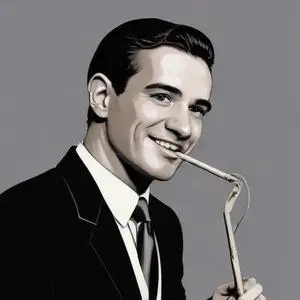
A renowned pianist who overcame the loss of his right arm in World War I to become a celebrated performer and educator, commissioning and premiering numerous left-hand piano concertos. He inspired generations of musicians and composers.
Paul Wittgenstein, an Austrian-American concert pianist, is renowned for commissioning new piano concerti for the left hand alone, a feat he achieved after the amputation of his right arm during World War I. His determination and innovative techniques enabled him to continue playing chords previously regarded as impossible for a five-fingered pianist.
Wittgenstein was born on November 5, 1887, in Vienna, Austria, to Karl Wittgenstein, an industrialist, and Leopoldine Maria Josefa Kalmus. He was raised in a culturally rich household, with frequent visits from prominent figures such as Johannes Brahms, Gustav Mahler, and Richard Strauss. His brother, Ludwig Wittgenstein, would later become a renowned philosopher.
Wittgenstein's musical talent was nurtured from an early age, and he began studying with Malvine Bre and later with Theodor Leschetizky, a Polish virtuoso. He made his public debut in 1913, receiving favorable reviews.
World War I broke out in 1914, and Wittgenstein was called up for military service. During the Battle of Galicia, he was shot in the elbow and captured by the Russians. His right arm had to be amputated, leaving him with a daunting prospect: relearning to play the piano with his left hand alone.
During his recovery in a prisoner-of-war camp in Omsk, Siberia, Wittgenstein resolved to continue his career as a pianist. He wrote to his old teacher, Josef Labor, asking for a concerto for the left hand, and Labor quickly responded, having already started work on a piece.
Following the war, Wittgenstein studied intensely, developing novel techniques, including pedal and hand-movement combinations, to overcome the challenges of playing with one hand. He commissioned new concerti from prominent composers, leading to a repertoire of left-hand concertos that would become his hallmark.
Wittgenstein's commissions resulted in a significant body of work, including concerti by renowned composers such as Maurice Ravel, Sergei Prokofiev, and Paul Hindemith. His collaborations with these composers led to a new era of piano music, expanding the possibilities of the instrument.
Paul Wittgenstein's determination and innovative spirit have inspired generations of pianists and composers. His legacy extends beyond his remarkable piano playing to the wealth of music he commissioned, which continues to enrich the classical music repertoire.
Wittgenstein passed away on March 3, 1961, leaving behind a testament to the power of human resilience and creativity in the face of adversity.
Born in 1889
A philosopher who challenged traditional philosophy by emphasizing the importance of language and its limits, and is famous for his philosophical ideas on logic, reality, and the nature of meaning.
Born in 1833
A renowned pianist and composer, he crafted complex, expressive works that blended traditional and innovative techniques, leaving an indelible mark on classical music.
Born in 1860
A visionary composer and conductor who expanded symphonic music's emotional depth and complexity, creating works of profound beauty and intensity.
Born in 1864
A renowned composer and conductor of the late Romantic era, known for his tone poems and operas that showcased his mastery of orchestration and expressive storytelling.
Born in 1897
A child prodigy turned Hollywood legend, he composed iconic film scores, including the swashbuckling adventures of Errol Flynn, and is revered for his lush, romantic music.
Born in 1863
A renowned pianist, composer, and conductor, known for his interpretations of Beethoven and Brahms, as well as his own symphonic works.
Born in 1897
A renowned conductor and composer, known for his precise and expressive performances, leading the Cleveland Orchestra to international acclaim. His interpretations of classical music remain highly influential.
Born in 1899
A renowned violinist and conductor, leading the Philadelphia Orchestra for over 40 years, known for his technical precision and interpretations of Romantic-era composers.
