


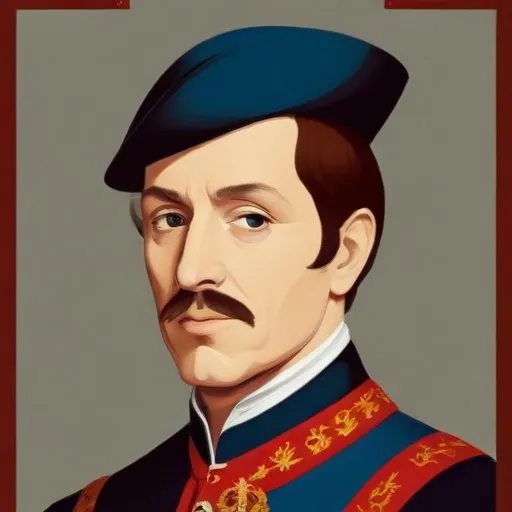
Ruler of Savoy from 1553 to 1580, known for his military campaigns and territorial expansions, particularly in the Italian Wars. He strengthened Savoy's position in Europe through strategic alliances and conquests.
Philibert I, Duke of Savoy, was a 15th-century Italian nobleman renowned for his brief but eventful reign as the Duke of Savoy from 1472 to 1482. Nicknamed "the Hunter," Philibert's life was marked by drama, romance, and tragedy, leaving an indelible mark on the history of Savoy.
Born on August 17, 1465, Philibert was the son of Amadeus IX, Duke of Savoy, and Yolande of Valois. Following his father's death in 1472, his mother became regent, securing Philibert's position as the rightful Duke of Savoy. At just seven years old, Philibert's life was already beset by turmoil, as Savoyard noblemen kidnapped him and held him captive in Turin.
The intervention of Louis XI of France led to Philibert's release, but his path was soon entwined with royalty once more. In 1474, he was betrothed to Bianca Maria Sforza, daughter of Galeazzo Maria Sforza of Milan, and his second wife, Bona of Savoy. This strategic union aimed to strengthen alliances between the Duchy of Savoy and the Duchy of Milan. Unfortunately, their marriage remained childless.
Philibert's life was cut short when he died of tuberculosis on September 22, 1482, at the tender age of 17. His brother Charles inherited the duchy, marking the beginning of a new era for Savoy. Despite his brief reign, Philibert's legacy endures, remembered for his resilience in the face of adversity and his attempts to forge alliances that would shape the future of Savoy.
Philibert's life serves as a testament to the complexities of 15th-century politics and the intricate web of royal alliances that defined the era. His story whispers tales of power struggles, family dynamics, and the delicate balance between duty and desire. As we gaze upon the tapestry of history, Philibert's thread is woven into the fabric of Savoy's story, a poignant reminder of the transient nature of life and the enduring impact of one's actions.
Philibert's story may be short, but its impact on the history of Savoy is profound. As we delve into the annals of time, we find ourselves drawn to the enigmatic figure of the "Hunter," a man who embodied the turbulent spirit of his era.
Born in 1500
Ruling over a vast empire from 1519 to 1556, he was a powerful and influential leader who played a crucial role in shaping European politics and religion. He is most known for his efforts to unify Christian Europe and defend it against the Ottoman Empire.
Born in 1519
King of France from 1547 to 1559, known for his cultural and artistic patronage, and his role in the Italian Wars.
Born in 1459
First Holy Roman Emperor to rule simultaneously as King of the Romans and King of Spain, known for uniting fragmented German states and establishing the Habsburg dynasty.
Born in 1503
The first Habsburg to rule the Holy Roman Empire, he unified Austria and introduced the concept of a hereditary monarchy, shaping European politics for centuries to come.
Born in 1757
The last Bourbon king of France, ruling from 1824 to 1830, known for his ultra-royalist views and attempts to restore absolute monarchy, leading to the July Revolution.
Born in 1519
King of France from 1547 to 1559, known for his cultural and artistic patronage, and his role in the Italian Wars.
