


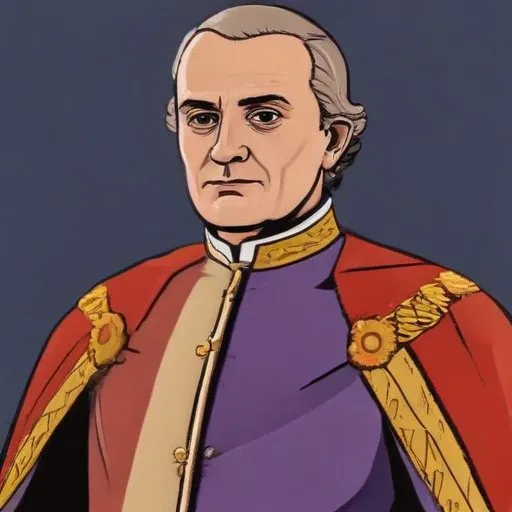
Elector of the Palatinate, a powerful German state, and a key figure in the Thirty Years' War, known for his military campaigns and territorial expansions.
Philip William, Elector Palatine, was a prominent figure in 17th-century European politics, renowned for his strategic leadership and cunning diplomacy. As the Elector of the Palatinate from 1685 to 1690, he played a pivotal role in navigating the complex web of alliances and rivalries that defined the era.
Born on November 24, 1615, to Wolfgang Wilhelm, Count Palatine of Neuburg, and Magdalene of Bavaria, Philip William was destined for greatness. His early life was marked by a strong education and a keen sense of politics, which would serve him well in his future endeavors.
In 1653, following the death of his father, Philip William inherited the title of Count Palatine of Neuburg, along with the duchies of Jülich and Berg. This marked the beginning of his remarkable journey, which would see him ascend to the Electorate of the Palatinate, a coveted position that carried significant influence and power.
In 1685, with the passing of his Protestant cousin, Charles II, Elector Palatine, Philip William inherited the Electorate of the Palatinate, cementing his position as a major player in European politics. This, however, was met with opposition from Charles II's sister, the Duchess of Orléans, who claimed the Palatinate for herself.
This dispute served as the catalyst for the Nine Years' War, a devastating conflict that would engulf Europe from 1688 to 1697. Philip William's cunning diplomacy and strategic alliances would prove crucial in navigating the complexities of this war, as he worked tirelessly to maintain the integrity of the Palatinate.
Philip William's personal life was marked by two significant marriages. His first marriage to Princess Anna Catherine Constance Vasa, daughter of Sigismund III Vasa and Constance of Austria, resulted in the birth of a son, who sadly died at birth. Anna Catherine Constance herself passed away in 1651.
In 1653, Philip William married Elisabeth Amalie of Hesse-Darmstadt, a union that would last for 37 years and produce 17 children, including the next two Palatine Electors, John William and Charles III Philip, as well as Elector-Archbishop Franz Ludwig von Pfalz-Neuburg. This remarkable legacy has endured to this day, with many of his descendants still prominent in European society.
Philip William's influence on European history is undeniable. His strategic leadership during the Nine Years' War, combined with his cunning diplomacy and forward-thinking policies, helped shape the course of European politics in the late 17th century.
Today, Philip William, Elector Palatine, is remembered as a true statesman, whose unwavering commitment to his people and his territory has left an indelible mark on the annals of history.
Born in 1661
The Elector Palatine was a German nobleman who ruled the Palatinate region and played a significant role in the War of the Spanish Succession. He's known for his diplomatic efforts and territorial expansions.
Born in 1478
Elector of the Palatinate, a powerful German state, and leader of the Protestant Union during the Thirty Years' War. He's known for his role in the early stages of this devastating conflict.
Born in 1596
The King of Bohemia who led the Protestant Union and briefly held the throne of Bohemia, sparking the Thirty Years' War. He's known for his short-lived but significant reign that had far-reaching consequences.
Born in 1504
A German nobleman who ruled Hesse from 1509 to 1567, known for being a champion of the Protestant Reformation and a key figure in the Schmalkaldic League.
Born in 1543
A German prince and count palatine who ruled Simmern and played a key role in the Protestant Reformation, supporting prominent reformers like John Calvin. He's also known for his military campaigns against the Ottoman Empire.
