


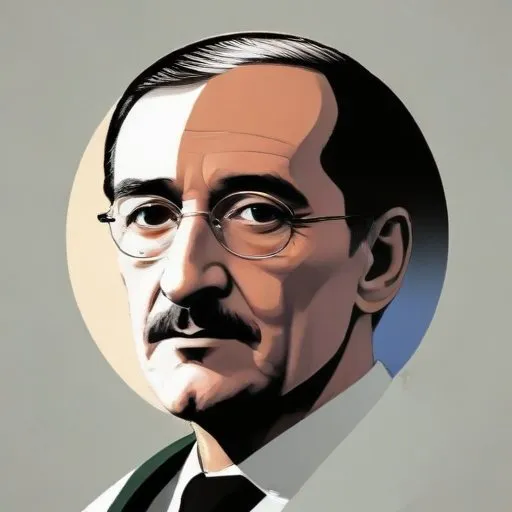
Developed the logistic curve, a mathematical model used to describe population growth and saturation, and is considered a pioneer in the field of demographics.
Pierre Franois Verhulst, a Belgian mathematician, is renowned for developing the logistic growth model, a fundamental concept in understanding population dynamics. His work, published in a series of three papers between 1838 and 1847, laid the foundation for modern demographics and has far-reaching implications in fields beyond mathematics.
Verhulst was born on October 28, 1804, in Brussels, Belgium. He pursued his passion for mathematics, earning a doctorate in number theory from the University of Ghent in 1825. Under the guidance of Adolphe Quetelet, a prominent statistician, Verhulst conducted research on modeling population growth, which would later become the cornerstone of his work.
Verhulst's most significant contribution is the logistic equation, which describes the growth of a population over time. The equation, published in 1838, is:
dN/dt = rN(1 - N/K)
where N represents the number of individuals at time t, r is the intrinsic growth rate, and K is the carrying capacity, or the maximum population size that the environment can support. This equation takes into account the effects of intraspecific competition, where the growth rate slows down as the population approaches its carrying capacity.
The logistic growth model has far-reaching implications in understanding population dynamics, ecology, and conservation. It has been applied in various fields, including:
Verhulst's work on the logistic growth model inspired later mathematicians, such as Raymond Pearl and Lowell Reed, who popularized the equation and extended its applications. Today, the logistic equation remains a fundamental tool in many fields, a testament to Verhulst's vision and contributions.
Verhulst's life was marked by dedication to his work, and he remained committed to advancing mathematical knowledge until his untimely death on February 15, 1849, in Brussels. Despite his passing, his legacy continues to inspire new generations of mathematicians and scientists.
Augustus De Morgan and Carl Friedrich Gauss. While his contemporaries made significant advances in algebra and geometry, Verhulst's focus on applied mathematics and population dynamics set him apart and paved the way for future breakthroughs.
Pierre Franois Verhulst's logistic growth model has become an indispensable tool in understanding complex systems and predicting population dynamics. His work continues to inspire research and applications in many fields, cementing his legacy as a visionary mathematician who has left an indelible mark on modern science.
Born in 1749
Developed nebular hypothesis of the origin of the solar system and formulated Laplace's equation, a fundamental concept in mathematics and physics. He's considered the founder of celestial mechanics.
Born in 1768
Developed the Fourier series, a mathematical tool used to decompose periodic functions into their component frequencies, and pioneered the study of heat transfer and thermodynamics.
Born in 1796
A pioneer in statistics and social physics, he applied mathematical models to understand social phenomena, paving the way for modern sociology and data analysis.
Born in 1789
Developed rigorous mathematical theories and introduced concepts like convergence and continuity, revolutionizing calculus and paving the way for modern mathematics.
Born in 1786
A mathematician and politician who made significant contributions to the development of electromagnetism and served as Prime Minister of France, advocating for social reform and education.
Born in 1774
A French polymath who made significant contributions to the fields of physics, astronomy, and mathematics, particularly in the discovery of chromatic polarization and the Biot-Savart law.
Born in 1777
A pioneer in mathematics and physics, he made major contributions to number theory, algebra, and electromagnetism, shaping our understanding of the natural world.
