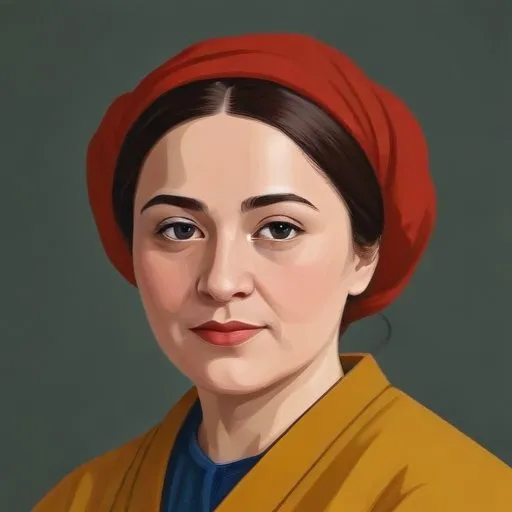
Raya Dunayevskaya: The Pioneering Philosopher of Marxist Humanism
A Champion of Human Liberation
Raya Dunayevskaya is renowned as the founder of the philosophy of Marxist humanism in the United States, a pioneering thinker who broke away from the traditional Marxist-Leninist dogma to forge a unique path that prioritized human freedom and dignity. Her groundbreaking work has had a profound impact on the development of Marxist thought, inspiring generations of scholars, activists, and intellectuals.
Early Life and Radicalization
Born Raya Shpigel on May 1, 1910, in the Podolia Governorate of the Russian Empire (present-day Ukraine), Dunayevskaya was raised in a family of Lithuanian Jewish descent. She emigrated to the United States in 1922, changing her name to Rae Spiegel, and was drawn to the revolutionary movement from a young age. Her early involvement in the American Communist Party's youth organization was marked by her questioning spirit, which eventually led to her expulsion at the age of 18.
Trotskyism and the Birth of Marxist Humanism
Dunayevskaya's association with
Leon Trotsky began in 1937, when she traveled to Mexico to serve as his Russian language secretary during his exile. However, her time with Trotsky was short-lived, as she disagreed with his stance on the Soviet Union's classification as a "workers' state" even after the Molotov-Ribbentrop Pact. This fundamental disagreement led to her break with Trotsky in 1939 and the development of her own philosophical framework, which she termed Marxist humanism.
The News and Letters Committees
In the 1950s, Dunayevskaya founded the News and Letters Committees, an organization dedicated to promoting her vision of Marxist humanism. As the organization's leader until her death in 1987, she nurtured a community of like-minded individuals who shared her commitment to human liberation and the rejection of state capitalism.
Philosophical Contributions and Beliefs
Dunayevskaya's philosophical contributions are characterized by her emphasis on the dignity and autonomy of the individual, which she saw as essential to the achievement of true human freedom. She rejected the notion that the Soviet Union was a "workers' state," instead arguing that it had become a state capitalist system. Her work also explored the intersections between Marxism, feminism, and humanism, inspiring new perspectives on the nature of revolutionary change.
Influence on Modern Society
Raya Dunayevskaya's thought has had a profound impact on modern society, influencing a wide range of intellectuals, activists, and scholars. Her emphasis on human liberation and dignity has inspired movements for social justice, feminism, and environmentalism, while her critique of state capitalism continues to resonate with those critical of neoliberalism and authoritarianism.
Major Works
- Marxism and Freedom: From 1776 Until Today (1958)
- Rosa Luxemburg, Women's Liberation, and Marx's Philosophy of Revolution (1982)
- Filipino Workers in the U.S. and the Philippines: A Comparative Study (1984)
Legacy and Historical Context
Raya Dunayevskaya's legacy is that of a pioneering thinker who dared to challenge the dominant interpretations of Marxism. Her philosophical framework, Marxist humanism, has inspired generations of scholars and activists to reimagine the possibilities of revolutionary change. As a testament to her enduring influence, Dunayevskaya's work continues to inspire new generations of thinkers and activists committed to the pursuit of human liberation and dignity.
FAQ
What was Raya Dunayevskayas role in Marxist philosophy?
Raya Dunayevskaya was a Ukrainian-American philosopher and activist who developed the philosophy of Marxist-Humanism, which emphasized the importance of human liberation and creativity in socialist thought.
What was Raya Dunayevskayas relationship with Leon Trotsky?
Dunayevskaya was a secretary and translator for Leon Trotsky in the 1930s, and later went on to develop her own philosophical and political ideas that diverged from Trotskys views.
What books did Raya Dunayevskaya write?
Dunayevskaya wrote several influential books on Marxist theory and philosophy, including Marxism and Freedom and Philosophy and Revolution.
What was Raya Dunayevskayas views on feminist theory?
Dunayevskaya was an early advocate for feminist theory and saw the struggle for womens liberation as a key part of the broader struggle for human liberation.
What is Raya Dunayevskayas legacy?
Dunayevskayas legacy is that of a pioneering Marxist philosopher and activist who developed a unique and influential philosophy that emphasized human liberation and creativity.