


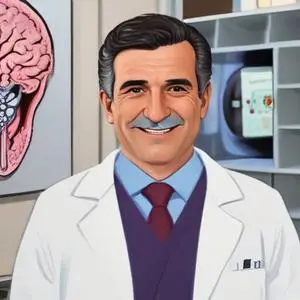
The Armenian-American inventor credited with creating the MRI (Magnetic Resonance Imaging) machine, revolutionizing medical diagnostics with non-invasive, high-resolution imaging.
As a physician and inventor, Damadian's tireless efforts to develop MRI technology have earned him numerous accolades and recognition. Born on March 16, 1936, in New York City, Damadian's early fascination with science and medicine led him to pursue a career that would change the course of medical history.
Damadian's Armenian immigrant parents instilled in him a strong work ethic and a passion for learning. He graduated from the Bronx High School of Science and went on to earn his Bachelor's degree in mathematics from the University of Wisconsin. He then attended the Albert Einstein College of Medicine, where he earned his M.D. in 1960.
In the early 1970s, Damadian became fascinated with the potential of nuclear magnetic resonance (NMR) technology to create images of the body. He realized that by using magnetic fields and radio waves, he could create detailed images of internal organs and tissues. After years of research and experimentation, Damadian built the first MRI machine in 1977.
Damadian's groundbreaking work has earned him numerous accolades, including:
Damadian's commitment to advancing medical science is driven by his strong Christian faith. He believes that his work is a way to honor God and serve humanity. His dedication to improving human health has inspired countless scientists and medical professionals.
Raymond Damadian's pioneering work in MRI technology has had a profound impact on modern medicine. His invention has enabled doctors to diagnose and treat diseases more effectively, saving countless lives. As a testament to his legacy, MRI machines are now an essential tool in hospitals around the world.
Damadian's story serves as a testament to the power of human ingenuity, perseverance, and faith. His remarkable journey is an inspiration to anyone pursuing a career in science, medicine, or technology.
Born in 1791
Pioneering scientist who discovered electromagnetic induction, formulated the laws of electrolysis, and invented the first electrical generator, revolutionizing our understanding of electricity and its applications.
Born in 1856
A pioneering engineer who harnessed the power of alternating current (AC) to transform the world's electrical systems, and is credited with developing groundbreaking technologies like radio communication and X-ray imaging.
Born in 1874
Developer of the first practical wireless telegraph, pioneering radio communication and earning a Nobel Prize in Physics. Known for revolutionizing long-distance communication.
Born in 1847
A Scottish-American engineer and academic credited with inventing the telephone, revolutionizing real-time communication. This innovation transformed the way people connect and conduct business.
Born in 1857
A pioneer in the field of electromagnetism, he discovered radio waves and proved James Clerk Maxwell's theories, paving the way for modern wireless communication. His experiments led to the development of radio, television, and mobile phones.
Born in 1831
Developed groundbreaking theories that unified electricity and magnetism, and predicted the existence of radio waves, revolutionizing our understanding of the physical world.
Born in 1845
Discoverer of X-rays, revolutionizing medical imaging and diagnostics. This groundbreaking innovation has saved countless lives and transformed the healthcare industry.
