


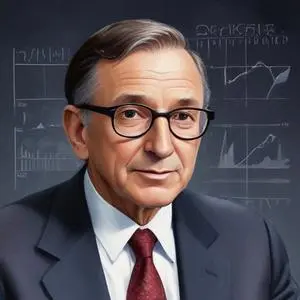
A Nobel Prize-winning economist and academic who pioneered the field of cliometrics, applying economic theory and quantitative methods to historical research, and was recognized for his work on the economics of slavery and railroads.
Robert Fogel, a renowned American economic historian and scientist, is best known for his pioneering work in the field of cliometrics, the application of economic theory and quantitative methods to study historical events. Alongside Douglass North, he was awarded the Nobel Memorial Prize in Economic Sciences in 1993 for his groundbreaking research that challenged traditional approaches to economic history.
Born on July 1, 1926, in New York City to Ukrainian Jewish immigrants, Fogel was shaped by his early life experiences. His brother, six years his senior, played a significant role in sparking his interest in social and economic issues during the Great Depression. Fogel graduated from Stuyvesant High School in 1944 and went on to study history at Cornell University, where he developed a passion for economics.
Fogel's initial involvement with the Communist Party, where he worked as a professional organizer for eight years, eventually led him to reject communism as unscientific. He then pursued an MA in economics from Columbia University under George Stigler in 1960. This marked a significant turning point in his academic journey, as he later received his PhD from Johns Hopkins University in 1963.
Fogel's research career spanned over four decades, during which he held positions at the University of Rochester, the University of Chicago, and Johns Hopkins University. He made substantial contributions to the field of cliometrics, publishing numerous papers and books that challenged traditional historiography. His work focused on applying economic theory and quantitative methods to understand historical events, bridging the gap between economics and history.
Fogel's work, along with Douglass North, sparked controversy among traditional historians, who saw their approach as reductionist and dismissive of historical context. This debate, known as the Fogel-North controversy, highlighted the tension between quantitative and qualitative approaches to historical research.
Fogel's contributions were widely recognized, earning him several prestigious awards, including:
Fogel's work has had a profound impact on the field of economic history, inspiring generations of scholars to adopt a more quantitative approach. His legacy extends beyond academia, influencing policy-making and informing discussions on economic development and growth.
"The new economic history is not a replacement for traditional history, but rather a complement to it."
Fogel's work continues to shape our understanding of economic history, challenging scholars and policymakers alike to re-examine their assumptions about the past and its relevance to the present.
Fogel's notable works include:
Fogel's remarkable career serves as a testament to his dedication to innovation and intellectual rigor, leaving an indelible mark on the field of economic history.
Born in 1912
A Nobel Prize-winning economist who championed free market capitalism and limited government intervention, known for his advocacy of laissez-faire economics and influential writings on monetary policy.
95 Years Old
A pioneer in applying economic theory to social issues, he's most known for his work on human capital, crime and punishment, and the economics of the family.
Born in 1915
A renowned economist and academic who made significant contributions to the field of economics, particularly in the areas of macroeconomics and international trade. He was awarded the Nobel Prize in Economics in 1970.
83 Years Old
A Nobel Prize-winning economist and academic who has made significant contributions to the field of economics, particularly in the areas of information economics and globalization.
92 Years Old
A renowned economist and philosopher who has made significant contributions to welfare economics, social choice theory, and development economics, and is known for his work on poverty, famine, and human development.
Born in 1920
A pioneer in institutional economics, he's renowned for his groundbreaking work on the role of institutions in shaping economic growth and development.
93 Years Old
A pioneering economist who challenged traditional theories by showing how communities can successfully manage shared resources, leading to a Nobel Prize in Economics in 2009.
Born in 1883
A pioneering economist who revolutionized modern economic theory with his groundbreaking ideas on government intervention and fiscal policy, shaping global economic policies.
