


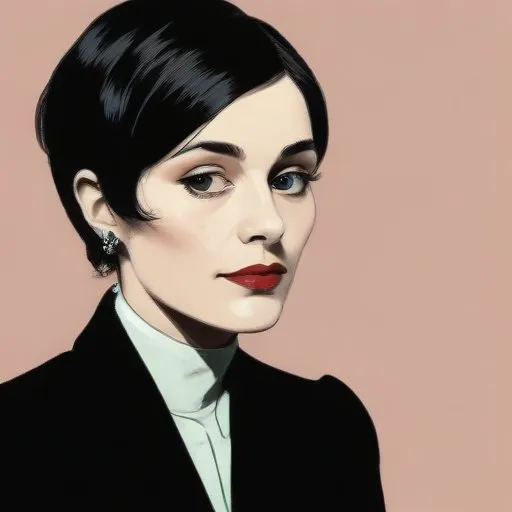
A pioneering artist of the early 20th century, known for her bold, androgynous portraits and landscapes that challenged traditional representations of gender and identity. Her work continues to inspire contemporary artists and LGBTQ+ communities.
Romaine Brooks, an American painter, is renowned for her captivating portraits of women in androgynous or masculine attire, showcasing her unique aesthetic inspired by the works of Charles Conder, Walter Sickert, and James McNeill Whistler. Ignoring contemporary artistic trends, Brooks developed a distinctive style characterized by a subdued tonal palette, often featuring gray as the dominant color.
Born Beatrice Romaine Goddard on May 1, 1874, in Rome, Italy, Brooks had an unhappy childhood marked by her father's abandonment and her mother's emotional abuse. Her brother suffered from mental illness, casting a shadow over her entire life.
Despite her family's wealth, Brooks spent several years struggling as a poor art student in Italy and France. However, upon her mother's death in 1902, she inherited a fortune, granting her the freedom to pursue her artistic vision and choose her subjects.
Brooks' portraits of women in androgynous or masculine dress are her most celebrated works, featuring subjects ranging from anonymous models to titled aristocrats. Her 1923 self-portrait, which is her most widely reproduced work, exemplifies her distinctive style and fascination with androgyny.
Brooks' subjects often included people close to her, such as the Italian writer and politician Gabriele D'Annunzio, the Russian dancer Ida Rubinstein, and her partner of over 50 years, the writer Natalie Barney. These relationships not only inspired her art but also influenced her life and career.
Despite the misconception that Brooks ceased painting after 1925, she continued to create art throughout her life. In the 1930s, she experimented with unpremeditated drawing techniques, predating automatic drawing. During this period, she also completed portraits of notable figures such as Carl Van Vechten and Muriel Draper.
Romaine Brooks' unique aesthetic and androgynous subjects continue to inspire artists and art enthusiasts today. Her legacy extends beyond her art, as she serves as a testament to the power of perseverance and artistic expression in the face of adversity.
"In her portraits, Brooks captures the essence of her subjects, often revealing their hidden selves. Her art is a testament to the power of human expression and the importance of embracing individuality."
Romaine Brooks' life and art serve as a testament to the transformative power of creativity and self-expression. Her legacy continues to inspire and influence artists, ensuring her place in the annals of art history.
As we reflect on Brooks' life and work, we are reminded of the importance of embracing individuality and celebrating the complexity of human identity. Her art and story will continue to captivate and inspire generations to come.
Born in 1876
A pioneering figure in the Parisian avant-garde, known for her lyrical poetry and plays that explored themes of love, desire, and feminism. Her salon gatherings brought together notable artists and intellectuals of the early 20th century.
Born in 1877
A pioneering lesbian writer, known for her lyrical poetry and novels exploring themes of love, desire, and identity. Her work was marked by its sensuality and emotional intensity.
Born in 1873
A pioneering female writer who broke social norms with her provocative novels and plays, exploring themes of love, sexuality, and independence.
Born in 1841
A pioneering Impressionist artist, capturing intimate, everyday moments of women's lives in delicate, dreamy paintings. Her works often blurred the lines between domesticity and artistry.
Born in 1844
An American Impressionist painter and educator, she created intimate, tender portraits of women and children, capturing the quiet beauty of everyday life. Her artwork often explored the complexities of motherhood and femininity.
Born in 1862
A pioneering female author of novels and short stories that explored the social conventions and morals of the Gilded Age, known for her witty and insightful portrayals of the American aristocracy.
