


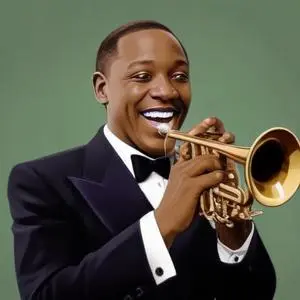
A virtuosic trumpet player and singer who helped bridge the gap between swing and bebop, known for his lightning-fast solos and distinctive vocal style.
Roy Eldridge, affectionately known as "Little Jazz," was an American jazz trumpeter who revolutionized the genre with his sophisticated use of harmony, virtuosic solos, and departure from the traditional style of jazz trumpet innovator Louis Armstrong. He is widely regarded as one of the most influential musicians of the swing era and a precursor of bebop.
Born on January 30, 1911, in Pittsburgh, Pennsylvania, Eldridge was exposed to music from a young age. His mother, Blanche, was a gifted pianist who could reproduce music by ear, and Eldridge claimed to have inherited this talent. His older brother, Joe Eldridge, was a multi-instrumentalist who encouraged Roy to take up the trumpet.
Roy began playing the piano at the age of five and soon transitioned to the drums. He played the bugle in a local church band and eventually picked up the trumpet, but it wasn't until the death of his mother and his father's remarriage that he began practicing more rigorously.
Eldridge's career spanned over four decades, during which he played with some of the most prominent jazz musicians of the time. He worked with Fletcher Henderson, Chick Webb, and Gene Krupa, among others, and was a member of the legendary Artie Shaw orchestra.
In the 1940s, Eldridge formed his own band, which became a breeding ground for young talent, including Dizzy Gillespie, who cited Eldridge as a major influence. Eldridge's virtuosic solos and sophisticated use of harmony, including tritone substitutions, paved the way for the development of bebop.
Roy Eldridge's impact on jazz cannot be overstated. He was a bridge between the swing era and bebop, and his influence can be heard in the playing of Dizzy Gillespie, Miles Davis, and other jazz legends.
Throughout his career, Eldridge received numerous awards and accolades, including a Grammy Lifetime Achievement Award. He continued to perform and record until his death on February 26, 1989, leaving behind a legacy that continues to inspire generations of jazz musicians.
"I was trying to play like Louis [Armstrong], but I was too fast. I was trying to play like Bix [Beiderbecke], but I was too slow. So I had to find my own way."
Roy Eldridge's story is one of passion, perseverance, and innovation. His legacy continues to inspire and influence jazz musicians around the world, cementing his place as one of the greatest trumpet virtuosos of all time.
Born in 1917
A virtuosic trumpet player and composer who revolutionized jazz with his lightning-fast solos and iconic puffy cheeks, creating a new language for the instrument. He's synonymous with bebop and modern jazz.
Born in 1920
A pioneering jazz saxophonist and composer, known for his lightning-fast solos and innovative bebop style that revolutionized jazz music. 82
Born in 1917
A jazz legend who revolutionized piano playing and composition with unorthodox techniques and harmonies, creating a unique, improvisational style that continues to inspire generations of musicians.
Born in 1904
A pioneering jazz musician who revolutionized the saxophone's role in jazz, creating a rich, full-bodied sound that influenced generations of musicians.
Born in 1909
A virtuosic clarinetist and bandleader, known as the "King of Swing," who revolutionized jazz music with his energetic and sophisticated style, leading a racially integrated orchestra in the 1930s.
Born in 1910
A virtuosic clarinetist and innovative bandleader, he revolutionized the swing era with his unique sound and iconic hits like "Begin the Beguine" and "Stardust".
Born in 1904
A legendary jazz pianist and bandleader who led a iconic orchestra, blending swing and blues to create a unique sound that influenced generations of musicians. Known for his distinctive "less-is-more" style and hits like "April in Paris" and "One O'Clock Jump".
Born in 1899
A legendary jazz pianist, composer, and bandleader who revolutionized the genre with his unique style and iconic compositions, such as "Take the A Train" and "Mood Indigo".
