


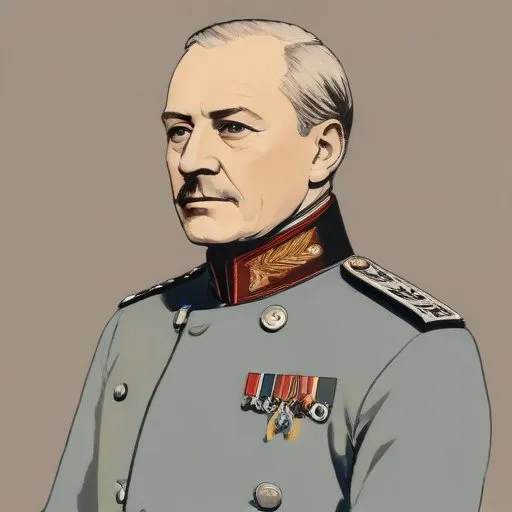
A German general who attempted to assassinate Adolf Hitler in 1943 by detonating a bomb in his briefcase, but Hitler escaped with minor injuries. He's known for his bravery in trying to take down the Nazi regime.
Rudolf Christoph Freiherr von Gersdorff was a German nobleman and army officer who is best known for his courageous attempt to assassinate Adolf Hitler in 1943. As a member of the German Resistance, von Gersdorff's bravery and conviction in the face of overwhelming danger have made him a hero of the Second World War.
Born on March 27, 1905, in Lüben, Silesia (now Lubin, Poland), von Gersdorff came from a long line of German nobility. He studied economics and philosophy at the University of Breslau and later joined the German Army in 1923. During the 1930s, von Gersdorff became increasingly disillusioned with the Nazi regime and its aggressive militarism, eventually joining the German Resistance movement.
In March 1943, von Gersdorff was tasked with escorting Hitler on a tour of the Zeughaus Berlin, a museum in Berlin. As they walked through the exhibit, von Gersdorff made a split-second decision to detonate a bomb hidden in his pocket, hoping to kill Hitler and spark a coup against the Nazi regime. However, the bomb failed to explode, and von Gersdorff was forced to quickly exit the scene, leaving behind his hat and coat.
The failed assassination attempt did not go unnoticed, and von Gersdorff was forced to go into hiding to avoid arrest and execution. He eventually joined the German Resistance group, Kreisau Circle, and continued to work towards overthrowing the Nazi regime. After the war, von Gersdorff was hailed as a hero and went on to become a prominent figure in post-war German politics.
Von Gersdorff's bravery and conviction have inspired generations of Germans and paved the way for modern-day resistance movements. His actions serve as a powerful reminder of the importance of standing up against tyranny and oppression, even in the face of overwhelming danger.
"I knew that if I did not succeed, I would be killed... But I also knew that I had to try."
Von Gersdorff's actions took place during a tumultuous period in German history, as the Nazi regime was consolidating its power and perpetrating atrocities across Europe. His bravery and conviction served as a beacon of hope for those opposed to the regime, and his legacy continues to inspire generations of Germans and people around the world.
Von Gersdorff's actions are often compared to those of Claus von Stauffenberg, another German officer who attempted to assassinate Hitler in 1944. While both men shared a similar goal, von Gersdorff's actions were motivated by a deeper sense of moral conviction and a commitment to democratic values.
Von Gersdorff's actions had a profound impact on the German military and the broader Resistance movement. His bravery and conviction served as an inspiration to others, and his legacy continues to shape the way Germans think about resistance and civil disobedience.
Von Gersdorff was awarded the Iron Cross, First Class, for his bravery during World War II. In 1964, he was awarded the Grand Cross of the Order of Merit of the Federal Republic of Germany.
Von Gersdorff's story serves as a powerful reminder of the importance of standing up against tyranny and oppression, even in the face of overwhelming danger. His bravery and conviction continue to inspire generations of Germans and people around the world, serving as a testament to the power of individual action and moral courage.
Born in 1889
The dictator of Nazi Germany, responsible for the genocide of six million Jews and millions of other people during World War II, and infamous for his extreme nationalist and anti-Semitic ideology.
Born in 1893
A high-ranking Nazi official, he was a decorated World War I fighter pilot and later became a prominent politician, serving as Minister President of Prussia. He's infamous for his role in the Nazi regime and war crimes trials.
Born in 1897
A mastermind of Nazi propaganda, he crafted a persuasive narrative that fueled the Third Reich's rise to power, leaving a lasting impact on the world.
Born in 1900
Leading the SS and Gestapo, he oversaw the Nazi regime's brutal security apparatus and implemented the "Final Solution," orchestrating the genocide of six million Jews during World War II.
Born in 1912
The longtime companion and eventually wife of the Nazi leader, known for her devotion to him and her ultimate fate of dying alongside him in the final days of World War II. She kept a private life, but her relationship with Hitler remains a subject of fascination and scrutiny.
Born in 1894
A high-ranking Nazi official who flew to Scotland on a solo mission to negotiate peace with the UK, but was instead arrested and imprisoned.
Born in 1893
A German diplomat who served as the Nazi regime's Foreign Minister, orchestrating key alliances and treaties that led to World War II. He was a close associate of Adolf Hitler and played a crucial role in shaping Nazi foreign policy.
Born in 1905
A prominent figure in Nazi Germany, serving as Minister of Armaments and War Production, known for his architectural designs and role in the war effort.
