


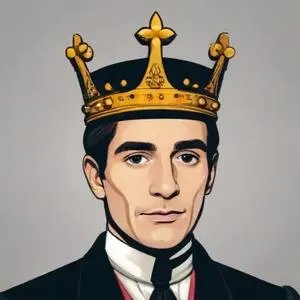
The heir to the Austro-Hungarian throne, known for his liberal views and tragic death in a murder-suicide pact with his mistress at Mayerling hunting lodge. His life and death have been the subject of numerous books, films, and operas.
Rudolf, Crown Prince of Austria, was the only son and third child of Emperor Franz Joseph I of Austria and Duchess Elisabeth of Bavaria, destined to inherit the imperial throne of the Austro-Hungarian Empire. However, his life was cut short in a tragic suicide pact with his mistress, Mary Vetsera, at the Mayerling hunting lodge in 1889, sending shockwaves across the continent.
Rudolf was born on August 21, 1858, at Schloss Laxenburg, a castle near Vienna, and was named after the first Habsburg King of Germany, Rudolf I. He was raised alongside his older sister Gisela, with whom he remained close despite being separated at the age of six to begin his education to become a future Emperor of Austria. This separation had a profound impact on Rudolf, and his initial education under Leopold Gondrecourt was reportedly physically and emotionally abusive, potentially contributing to his later struggles.
Influenced by his tutor Ferdinand von Hochstetter, Rudolf developed a fascination with natural sciences, starting a mineral collection at a young age. This interest in science led to a vast collection, which after his death, was largely acquired by the University of Agriculture in Vienna, now known as the University of Natural Resources and Life Sciences, Vienna.
Unlike his deeply conservative father, Rudolf held liberal views, aligning more closely with those of his mother, Empress Elisabeth. However, his relationship with her was often strained, likely due to the pressures of his royal upbringing and the weight of his future responsibilities.
In 1881, Rudolf married Princess Stéphanie of Belgium, but the union was marked by infidelity and tragedy. His affair with Mary Vetsera, a young and beautiful Baroness, led to a devastating conclusion, as the two lovers were found dead in a suicide pact at the Mayerling hunting lodge on January 30, 1889.
Rudolf's tragic demise sent shockwaves across Europe, and his legacy continues to intrigue and fascinate to this day. His love of natural sciences and his liberal views have been overshadowed by the scandal surrounding his death, but they remain an important part of his story. Despite the tragedy that befell him, Rudolf's life serves as a poignant reminder of the pressures and expectations that come with royal life.
"I am tired of life, and the world is tired of me."
Rudolf's tragic story serves as a cautionary tale of the pressures of royalty and the devastating consequences of untamed passion. As we reflect on his life, we are reminded of the importance of compassion, understanding, and the need to confront the darkness that can lurk within.
Born in 1830
The longest-reigning ruler of Austria-Hungary, presiding over a vast empire that spanned across Central Europe, and remembered for his role in shaping European history through diplomacy and war.
Born in 1887
Last Emperor of Austria-Hungary, ruling from 1916 to 1918, and known for his attempts to reform the empire and end World War I.
Born in 1892
The last Empress of the Austro-Hungarian Empire, a symbol of a bygone era, known for her courage and dedication to her husband and family during World War I. She was a unifying figure, beloved by her people.
Born in 1868
Led a right-wing authoritarian government in Hungary between the two World Wars, known for his anti-Semitic and nationalist policies. He collaborated with Nazi Germany during World War II.
Born in 1894
A Bosnian Serb revolutionary who assassinated Archduke Franz Ferdinand of Austria, sparking World War I. This event changed the course of history, leading to widespread devastation and global repercussions.
