


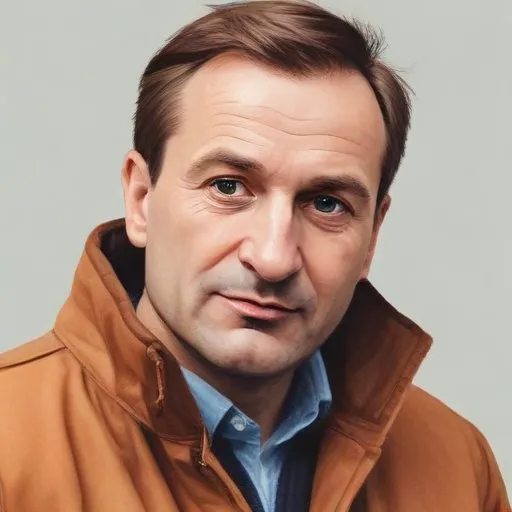
A renowned Polish journalist, photographer, and poet who traveled to over 50 countries, capturing the human experience through his writing and images, particularly in war-torn and developing nations.
Ryszard Kapucinski was a renowned Polish journalist, photographer, poet, and author, celebrated for his unconventional reporting style, which blurred the lines between journalism and literature. He is best known for his poignant and vivid accounts of wars, revolutions, and coups, which earned him numerous awards and nominations for the Nobel Prize in Literature.
Born on March 4, 1932, in Pinsk, Poland (now in Belarus), Kapucinski grew up in a tumultuous era, witnessing the horrors of World War II and the subsequent Soviet occupation. This experience shaped his perspective and fueled his passion for journalism, leading him to become the Polish Press Agency's only correspondent in Africa during decolonization.
Kapucinski's time in Africa (1956-1981) was a defining period in his career. He reported on 27 revolutions and coups, covering stories that mainstream media often overlooked. His experiences during this period inspired his most notable works, including Jeszcze dzień życia (Another Day of Life), an account of the Angolan War of Independence, and Cesarz (The Emperor), a satire of Communist Poland, set against the backdrop of Ethiopian ruler Haile Selassie's downfall.
Kapucinski's unique style, which blended reportage with allegory and magical realism, earned him the title "Maestro" from fellow writers, including Tiziano Terzani, Gabriel García Márquez, and Luis Sepúlveda. His work inspired a new generation of journalists and writers, who adopted his innovative approach to storytelling.
Kapucinski received numerous awards for his work, including the Prince of Asturias Award for Literature, the Samuel Johnson Prize, and the Ryszard Kapuściński Award for Literary Reporting. His legacy extends beyond his writing, inspiring a new generation of journalists and writers to adopt his innovative approach to storytelling.
Kapucinski's life was not without controversy. He was fired from the Polish Press Agency for his support of the pro-democracy Solidarity movement in Poland. Despite this, he continued to write, producing some of his most acclaimed works during this period.
Ryszard Kapucinski's work is a testament to the power of storytelling, blurring the lines between journalism and literature. His poetic prose, infused with empathy and insight, continues to inspire readers and writers alike, cementing his place as one of the greatest journalists and authors of the 20th century.
98 Years Old
A physician-turned-revolutionary, he led Cuba's socialist revolution and became an iconic symbol of Marxism, inspiring social change worldwide. His image and ideals continue to influence modern politics and activism.
Born in 1926
The Cuban revolutionary who led the country from 1959 to 2008, implementing socialist policies and defying US opposition, becoming an iconic figure in modern history.
Born in 1904
A Chilean poet and diplomat who wrote passionate and evocative poetry that explored love, politics, and the human condition, and was awarded the Nobel Prize in Literature in 1971.
Born in 1905
Existentialist philosopher and playwright who argued that humans have complete freedom to choose their actions and create their own meaning in life, influencing modern thought on morality and individual responsibility.
Born in 1908
A pioneering feminist philosopher who wrote extensively on ethics, politics, and gender, famously arguing that "one is not born, but rather becomes, a woman."
93 Years Old
A renowned writer and thinker who explored the human experience through novels, essays, and criticism, delving into topics like culture, politics, and morality. Known for her provocative ideas and lyrical prose.
99 Years Old
A renowned German writer and artist, celebrated for his influential and provocative works that explored the human condition, morality, and the complexities of German history and identity.
89 Years Old
A pioneering journalist and author who blurred the lines between fiction and reality, creating a unique brand of Gonzo journalism that captivated readers with its unapologetic honesty and dark humor.
