


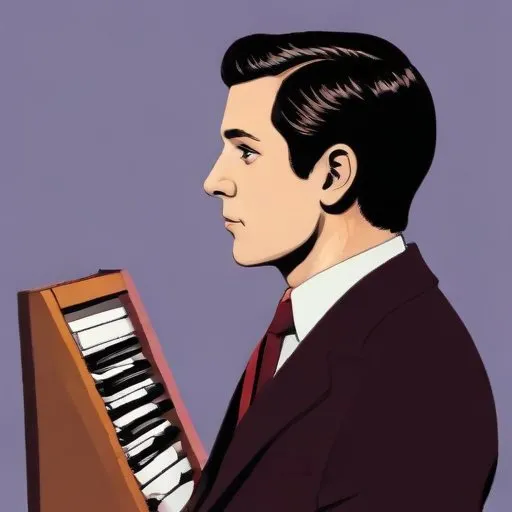
Noted for his contributions to American church music, he composed numerous hymns, choral works, and organ pieces, leaving a lasting legacy in the world of sacred music.
Seth Bingham, an American organist and composer, left an indelible mark on the world of classical music with his vast array of orchestral, choral, and chamber music compositions. However, it is his works for organ solo that truly showcase his mastery and artistic prowess.
Born on April 16, 1882, in Bloomfield, New Jersey, Bingham was the youngest of four siblings in a farming family that soon relocated to Naugatuck, Connecticut. His early life was steeped in church music, which laid the foundation for his future endeavors.
He pursued his passion for music at Yale University, studying organ and composition with Harry Benjamin Jepson and Horatio Parker. Bingham's talent and dedication earned him a B.A. in 1904. He further honed his skills in Paris, studying with renowned musicians Alexandre Guilmant, Vincent d'Indy, and Charles-Marie Widor.
Upon returning to the United States, Bingham taught theory, composition, and organ at Yale University from 1908 to 1919. He went on to hold the position of organist and choirmaster at Madison Avenue Presbyterian Church in New York City from 1913 to 1951.
In addition to his ministerial duties, Bingham was an associate professor at Columbia University from 1922 to 1954. He also lectured at the School of Sacred Music at Union Theological Seminary from 1953 to 1965. Throughout his tenure, he guided students, including the notable Jeanne Walsh Singer.
Bingham's compositional output is staggering, with works encompassing orchestral, choral, and chamber music. However, it is his organ solo compositions that remain his most celebrated and enduring creations.
Two of his most notable works are Roulade, from Six Pieces for Organ, Op. 9, No. 3 (1923), dedicated to David McKinley Williams, and Suite for Organ, Baroques, Op. 41 (1944), dedicated to E. Power Biggs. This suite consists of five movements:
Bingham married Blanche Guy in Switzerland in 1907, and the couple had two children and three grandchildren. He passed away on June 21, 1972, in New York City, at the age of 90, leaving behind a legacy of music that continues to inspire generations of musicians and music lovers.
A testament to his contributions, Bingham received an honorary doctorate from Ohio Wesleyan University in 1952. His archives are preserved at the Music Division of the New York Public Library for the Performing Arts, ensuring that his life's work remains accessible to scholars and enthusiasts alike.
Born in 1912
A renowned organist and composer, known for his virtuosic performances and innovative compositions that blended classical and modern styles. He was a prominent figure in the American classical music scene during the mid-20th century.
Born in 1886
A renowned French organist and composer, known for his virtuosic performances and contributions to the organ repertoire, including symphonic poems and chamber music.
Born in 1882
A renowned conductor who revolutionized the art of orchestral performance with his innovative techniques and charismatic stage presence, leading iconic ensembles like the Philadelphia Orchestra.
Born in 1899
A renowned violinist and conductor, leading the Philadelphia Orchestra for over 40 years, known for his technical precision and interpretations of Romantic-era composers.
Born in 1926
A renowned organist, composer, and conductor, he was a prominent figure in American classical music, particularly in the development of organ repertoire and pedagogy.
