


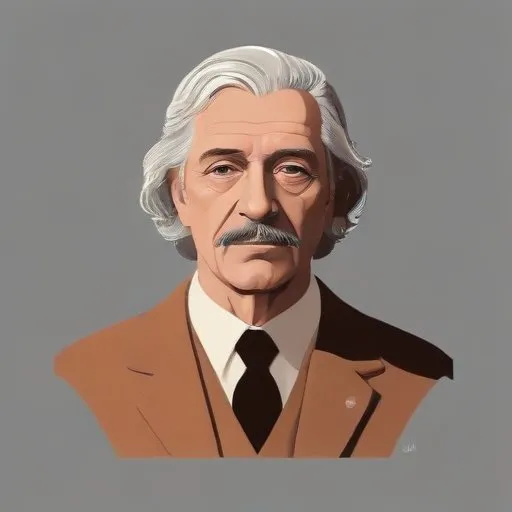
A pioneer in electrical engineering, known for his groundbreaking work on electromagnetism and authoring influential textbooks that shaped the field.
Silvanus P. Thompson, an English professor of physics, is best known for his groundbreaking work in electrical engineering and his influential textbook, Calculus Made Easy, which has remained in print since its publication in 1910. This iconic book has introduced the fundamentals of infinitesimal calculus to generations of students and professionals alike, cementing Thompson's legacy as a pioneering educator and author.
Born on June 19, 1851, to a Quaker family in York, England, Thompson grew up in a household that valued education and intellectual pursuits. His father, a master at the Quaker Bootham School, instilled in him a love for learning, which eventually led Thompson to study at the University of London, where he earned his Bachelor of Arts degree in 1869.
Following his degree, Thompson completed a teaching apprenticeship and went on to study chemistry and physics at the Royal School of Mines in South Kensington. He graduated with honors, earning his Bachelor of Science degree, and soon became a Fellow of the Royal Astronomical and Physical Society.
Thompson's academic and professional career was marked by several significant milestones. In 1876, he was appointed as a lecturer in physics at University College, Bristol, and later became Professor at the age of 27. He was also awarded a D.Sc. from the University of London in 1878.
Thompson's most notable works include:
Thompson's contributions to electrical engineering and education have had a lasting impact on modern society. His work in technical education has inspired generations of engineers and scientists, paving the way for significant advancements in fields such as electrical power systems, telecommunications, and computer science.
His books, particularly Calculus Made Easy, have made complex mathematical concepts accessible to a broader audience, enabling students and professionals to develop a deeper understanding of the underlying principles of electrical engineering and physics.
In recognition of his contributions to science and education, Thompson was elected to the Royal Society in 1891. This prestigious honor is a testament to his dedication to advancing knowledge and promoting educational excellence.
Silvanus P. Thompson's legacy extends far beyond his own lifetime. His work has inspired countless individuals to pursue careers in electrical engineering and related fields, shaping the course of modern technology and innovation. His books remain essential reading for students and professionals, ensuring that his ideas and contributions continue to influence future generations.
Born in 1831
Developed groundbreaking theories that unified electricity and magnetism, and predicted the existence of radio waves, revolutionizing our understanding of the physical world.
Born in 1791
Pioneering scientist who discovered electromagnetic induction, formulated the laws of electrolysis, and invented the first electrical generator, revolutionizing our understanding of electricity and its applications.
Born in 1821
A 19th-century physician and physicist who made significant contributions to the fields of electromagnetism, thermodynamics, and the physiology of human perception, particularly in the study of vision and hearing.
Born in 1822
Developed the theory of thermodynamics, introducing the concept of entropy, and made significant contributions to the fields of electricity and magnetism.
Born in 1818
A pioneer in thermodynamics, he discovered the relationship between mechanical work and heat, leading to the development of the laws of thermodynamics. His work laid the foundation for modern physics and engineering.
Born in 1850
Developed groundbreaking theories in electromagnetism and telecommunication, and is credited with reformulating Maxwell's equations into their modern form. His work laid the foundation for modern electrical engineering and communication systems.
Born in 1857
A pioneer in the field of electromagnetism, he discovered radio waves and proved James Clerk Maxwell's theories, paving the way for modern wireless communication. His experiments led to the development of radio, television, and mobile phones.
