


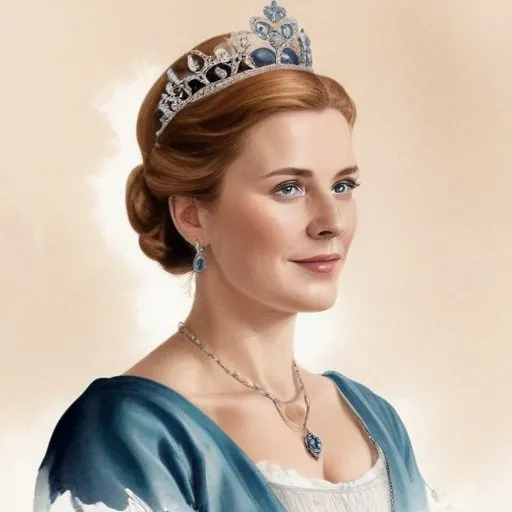
Queen consort of Denmark and Norway, known for her strong character and influence on her husband, King Frederick II, during the 16th century. She played a significant role in promoting the Lutheran Reformation in Denmark.
Sophie of Mecklenburg-Gstrow, Queen of Denmark and Norway, was a woman of unyielding intellectual curiosity and remarkable financial prowess. She is remembered for her profound impact on the scientific community, her shrewd business acumen, and her significant influence on Danish and Northern European politics during her lifetime.
In 1572, Sophie married her cousin, Frederick II of Denmark, in a union that would last for over a decade. While her marriage was marked by a lack of direct political influence, Sophie maintained her own court and exercised a degree of autonomy over patronages. Her interest in astrology, chemistry, alchemy, and iatrochemistry led her to support and visit the renowned scientist Tycho Brahe on the island of Ven in 1586.
Widowed at the age of 31, Sophie went on to amass an enormous fortune through the skilled management of her vast estates. She became the richest woman in Northern Europe and the second wealthiest individual in Europe, after Maximillian I of Bavaria. Her inexhaustible coffers enabled her to financially support her son, Christian IV of Denmark, and thereby the entire Danish-Norwegian state.
When Sophie died in 1631, James Howell, a 17th-century Anglo-Welsh historian and writer, remarked that she was the richest Queen in Christendom. Her remarkable life is a testament to her intellectual capacity, financial acumen, and philanthropic spirit, earning her a place in history as one of the most influential and intelligent women of her time.
Sophie's patronage of scientists and her interest in the natural sciences have inspired generations of women to pursue careers in STEM fields. Her remarkable life has also inspired numerous literary and artistic works, cementing her place in popular culture.
While no direct quotes from Sophie of Mecklenburg-Gstrow have been recorded, her remarkable life and accomplishments serve as a testament to her indomitable spirit and intellect.
Sophie's life and legacy are a reflection of the complex and tumultuous nature of 16th- and 17th-century European politics. Her remarkable achievements in the face of adversity serve as a testament to her strength, intelligence, and determination, making her a truly remarkable historical figure.
Sophie's life and accomplishments can be compared to those of other influential women of her time, including Queen Elizabeth I of England and Catherine de' Medici of France. While each of these women left their mark on history, Sophie's unique blend of intellectual curiosity, financial acumen, and philanthropic spirit sets her apart as a truly remarkable individual.
Born in 1609
King of Denmark and Norway from 1648 to 1670, known for establishing absolute monarchy and modernizing Denmark's administration.
Born in 1749
King of Denmark and Norway from 1766 to 1808, known for his mental health issues and scandals, which led to a regency that ruled in his place.
Born in 1818
The King of Denmark who unified the country and founded the modern Danish monarchy, known for his strong leadership and family ties to European royal houses.
Born in 1609
King of Denmark and Norway from 1648 to 1670, known for establishing absolute monarchy and modernizing Denmark's administration.
Born in 1577
A 17th-century king who ruled Denmark and Norway, known for his ambitious projects, including the construction of Rosenborg Castle and the founding of the city of Kristiansand. He's also famous for his military endeavors, particularly the Thirty Years' War.
Born in 1723
King of Denmark and Norway from 1746 to 1766, known for his cultural and economic reforms, as well as his patronage of the arts.
Born in 1749
King of Denmark and Norway from 1766 to 1808, known for his mental health issues and scandals, which led to a regency that ruled in his place.
