


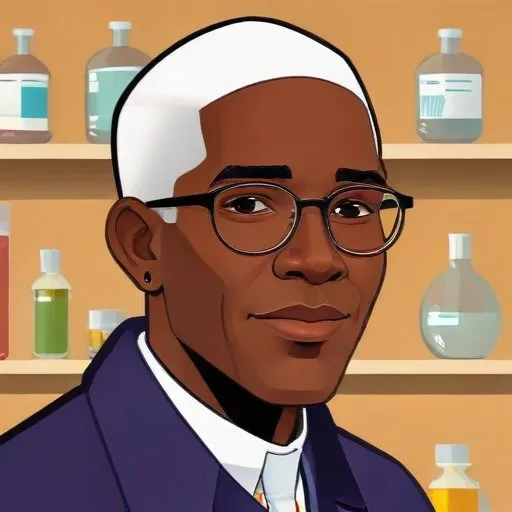
Pioneering African American chemist and educator who broke racial barriers in academia, earning a Ph.D. in chemistry and teaching at several prestigious universities. He was a trailblazer for diversity in STEM education.
St. Elmo Brady was a trailblazing American chemist who made history in 1916 by becoming the first African American to obtain a Ph.D. in chemistry in the United States. This groundbreaking achievement marked a significant milestone in the fight against racial barriers in education and paved the way for future generations of African American scientists.
Born on December 22, 1884, in Louisville, Kentucky, Brady was influenced by Thomas W. Talley, a pioneer in science education. He earned his bachelor's degree from Fisk University in 1908 at the age of 24 and began teaching at Tuskegee Institute in Alabama.
Brady's close relationships with prominent figures such as Booker T. Washington and George Washington Carver played a significant role in shaping his academic and professional pursuits. In 1912, he received a scholarship to the University of Illinois, where he pursued graduate studies and earned his M.S. in chemistry in 1914.
During his time at the University of Illinois, Brady published three scholarly abstracts in Science in 1914-1915 on his work with Professor Clarence Derick. He also collaborated with Professor George Beal on a paper published in Journal of Industrial and Engineering Chemistry titled, "The Hydrochloride Method for the Determination of Alkaloids."
Brady's Ph.D. thesis, "The Divalent Oxygen Atom," was completed in 1916 under the direction of Derick at Noyes Laboratory. This achievement marked a significant milestone in his career, solidifying his position as a leading chemist of his time.
St. Elmo Brady's legacy extends far beyond his academic achievements. He was the first African American admitted to the University of Illinois's chemical honor society, Phi Lambda Upsilon, in 1914. This recognition was a testament to his exceptional academic abilities and his determination to succeed in a field dominated by white scholars.
As a role model and pioneer, Brady inspired future generations of African American scientists to pursue careers in chemistry and related fields. His contributions to the scientific community continue to be celebrated, and his legacy serves as a beacon of hope for those seeking to break down racial barriers in education and beyond.
These monographs, along with his scholarly articles and collaborative research, demonstrate Brady's commitment to sharing knowledge and advancing the field of chemistry.
In addition to his academic achievements, Brady was a member of Alpha Phi Alpha fraternity and maintained close relationships with prominent figures of his time.
Throughout his life, Brady remained dedicated to his craft, leaving a lasting impact on the scientific community and paving the way for future generations of African American scientists.
Born in 1856
A pioneering figure in African-American education, he founded the Tuskegee Institute and advocated for racial uplift through self-improvement and economic empowerment. His autobiography, "Up from Slavery," remains a classic of American literature.
Born in 1868
A pioneering figure in the struggle for racial equality, advocating for civil rights and social justice through groundbreaking research and powerful writings.
Born in 1897
A renowned contralto who broke racial barriers in the music industry, performing at the White House and becoming a symbol of the Civil Rights Movement.
Born in 1908
A trailblazing lawyer and civil rights champion who broke racial barriers in the US justice system, serving as the first African American on the Supreme Court. He fought tirelessly for equality and justice, leaving a lasting impact on American history.
Born in 1904
A pioneering diplomat and Nobel laureate who brokered peace in the Middle East and advocated for civil rights, leaving a lasting impact on international relations and social justice.
Born in 1902
A renowned poet, novelist, and playwright who powerfully voiced the experiences and struggles of African Americans during the Harlem Renaissance, using jazz and blues rhythms to convey the spirit of his people.
Born in 1891
A celebrated author and anthropologist who explored African-American culture through novels, stories, and folklore, particularly in the rural South during the early 20th century.
Born in 1899
A legendary jazz pianist, composer, and bandleader who revolutionized the genre with his unique style and iconic compositions, such as "Take the A Train" and "Mood Indigo".
