


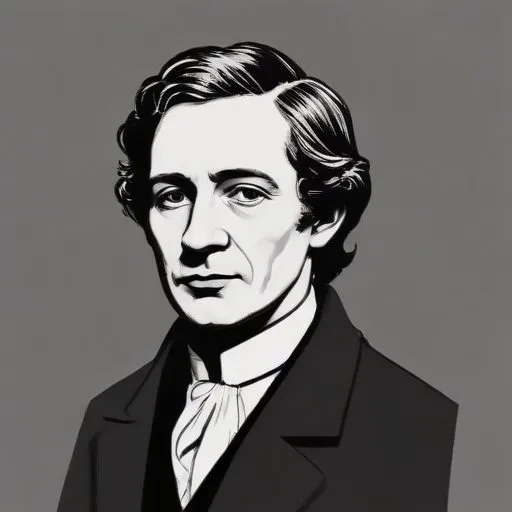
A Chartist poet and writer, known for his radical politics and advocacy for workers' rights, leaving a mark on British social reform.
Thomas Cooper, a renowned English poet and leading Chartist, is best known for his prison rhyme, The Purgatory of Suicides, which spans an impressive 944 stanzas. This monumental work, written during his two-year imprisonment in Stafford, showcases his unwavering passion and determination.
Born on March 20, 1805, in Leicester, Cooper's early life was marked by hardship and difficulties. After his father's death, his mother started a business as a dyer and fancy boxmaker in Gainsborough, Lincolnshire. Cooper was apprenticed to a shoemaker, but he didn't let his circumstances hold him back. Through sheer determination, he managed to educate himself, eventually opening his own school in Gainsborough at the age of 23.
Cooper's involvement in the Chartist movement began in 1840, when he joined the staff of the Leicestershire Mercury. He quickly became a leader and lecturer, inspiring many with his fiery passion and conviction. His leadership in Leicester made the city a Chartist stronghold, with its own journals and adult education schools. However, his activism led to his imprisonment in 1842 for inciting riots in the Staffordshire Potteries.
During his imprisonment, Cooper wrote The Purgatory of Suicides, a political epic that showcases his mastery of poetry. Upon his release, he secured the help of Benjamin Disraeli and Douglas Jerrold, leading to the publication of his work in 1845. Cooper's literary contributions didn't stop there; he went on to write novels and religious texts in later life.
Cooper's contributions to the Chartist movement and his literary works have had a lasting impact on modern society. His poetry and writings inspired many to fight for social justice and equality, leaving a legacy that continues to inspire generations.
Cooper's writings reflect his strong belief in social justice and equality. Through his poetry and activism, he advocated for the rights of the working class, inspiring a generation of Chartists and social reformers.
Born in 1770
A major Romantic poet, known for his focus on nature, emotion, and the human experience, creating works that evoke a sense of wonder and connection to the natural world.
Born in 1772
A leading figure of the Romantic movement, he crafted vivid, imaginative poetry and explored the human experience through his writing and philosophical ideas. His works continue to inspire and influence literature and art to this day.
Born in 1788
Romantic poet and playwright celebrated for passionate, expressive works that explored themes of love, freedom, and the human condition.
Born in 1792
Romantic-era writer of lyrical poetry and Gothic dramas that explored the human condition, freedom, and the beauty of nature.
Born in 1795
Romantic poet celebrated for sensual language and vivid imagery, capturing the beauty of nature and human experience in odes like "To Autumn" and "Ode to a Nightingale".
Born in 1774
A leading Romantic poet and historian, known for his vivid storytelling and influential works on British history, particularly his three-volume "Life of Nelson".
Born in 1771
A renowned author of historical novels, plays, and poetry, credited with creating the genre of historical fiction and influencing the development of the novel as a literary form.
Born in 1759
Celebrated for his poignant and lyrical poetry, he penned iconic works that capture the essence of Scottish culture and identity. His contributions to literature continue to inspire and delight readers worldwide.
