


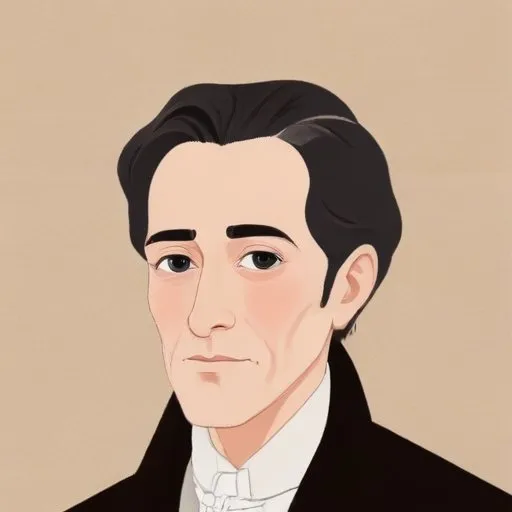
A Romantic-era poet, playwright, and physician who explored themes of death, nature, and the human psyche through his works, particularly in his poetry collection "Death's Jest-Book".
Thomas Lovell Beddoes was a British poet, dramatist, and physician, notorious for his dark and intricate works that probed the mysteries of death and the human spirit. His writings, characterized by their rich diction and thought-provoking themes, continue to captivate readers to this day.
Beddoes was born on June 30, 1803, in Clifton, Bristol, England, to Dr. Thomas Beddoes, a friend of the celebrated poet Samuel Taylor Coleridge, and Anna, sister of the renowned author Maria Edgeworth. He received his education at Charterhouse and Pembroke College, Oxford, where he fostered a deep appreciation for literature and the arts.
Beddoes' literary career commenced with the publication of his poem "The Improvisatore" in 1821, which he later attempted to suppress. However, his subsequent work, "The Brides' Tragedy" (1822), a blank-verse drama, earned him critical acclaim and the admiration of fellow poet Barry Cornwall.
Throughout his career, Beddoes' work was marked by a recurring preoccupation with death, a theme that he explored with unflinching intensity. His writing often delved into the mysteries of mortality, probing the nature of human existence and the possibility of a spirit that survives bodily death.
In 1824, Beddoes traveled to Göttingen to study medicine, driven by his desire to uncover physical evidence of a human spirit that endures beyond death. He was eventually expelled from Göttingen and continued his medical training in Würzburg. His subsequent years were marked by a peripatetic existence, during which he practiced medicine, expounded democratic theories, and wrote prolifically.
Beddoes' wanderings took him to Bavaria, where he was deported in 1833, and later to Zurich, where he was forced to leave in 1840. He eventually returned to England in 1846, only to depart for Germany again.
Beddoes' later years were marred by personal turmoil and a deepening sense of despair. He became increasingly disturbed, ultimately taking his own life by poison in Basel, Switzerland, on January 26, 1849, at the age of 45.
After his death, his friend T. F. Kelsall published Beddoes' unfinished drama, "Death's Jest-Book," in 1850, accompanied by a memoir. His "Collected Poems" followed in 1851. Despite the criticisms leveled against him as a dramatist, Beddoes' poetry continues to be celebrated for its richness and thought-provoking themes.
Beddoes' work, though often shrouded in darkness and morbidity, continues to captivate readers with its profound exploration of the human condition. His poetry and dramas have influenced generations of writers, poets, and thinkers, ensuring his legacy as a prominent figure in British literary history.
Despite his tumultuous life and tragic end, Thomas Lovell Beddoes' works remain a testament to his boundless creativity, intellectual curiosity, and unwavering commitment to exploring the mysteries of human existence.
Born in 1788
Romantic poet and playwright celebrated for passionate, expressive works that explored themes of love, freedom, and the human condition.
Born in 1792
Romantic-era writer of lyrical poetry and Gothic dramas that explored the human condition, freedom, and the beauty of nature.
Born in 1795
Romantic poet celebrated for sensual language and vivid imagery, capturing the beauty of nature and human experience in odes like "To Autumn" and "Ode to a Nightingale".
Born in 1797
Author of Gothic novels, particularly the iconic "Frankenstein", which has become a cultural phenomenon and influenced countless adaptations and reinterpretations.
Born in 1770
A major Romantic poet, known for his focus on nature, emotion, and the human experience, creating works that evoke a sense of wonder and connection to the natural world.
Born in 1772
A leading figure of the Romantic movement, he crafted vivid, imaginative poetry and explored the human experience through his writing and philosophical ideas. His works continue to inspire and influence literature and art to this day.
Born in 1774
A leading Romantic poet and historian, known for his vivid storytelling and influential works on British history, particularly his three-volume "Life of Nelson".
Born in 1771
A renowned author of historical novels, plays, and poetry, credited with creating the genre of historical fiction and influencing the development of the novel as a literary form.
