


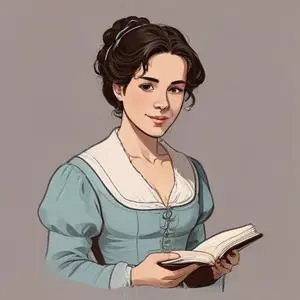
This Anglo-Irish author is celebrated for her influential novels of manners, which offered insightful commentary on the social and cultural norms of her time, particularly in Ireland. Her works are still studied for their historical significance and literary merit.
Maria Edgeworth was a prolific Anglo-Irish novelist of adults' and children's literature, renowned for her groundbreaking realism in children's literature and significant contributions to the evolution of the novel in Europe. Her works, particularly her debut novel Castle Rackrent, have left an indelible mark on the literary world, earning her a place among the most celebrated authors of her time.
Born on January 1, 1768, in Black Bourton, Oxfordshire, Maria was the second child of Richard Lovell Edgeworth and Anna Maria Edgeworth (née Elers). Following her mother's death when Maria was just five years old, she spent her early years with her maternal family in England, living at The Limes (now known as Edgeworth House) in Northchurch, Hertfordshire.
After her father's remarriage to Honora Sneyd in 1773, Maria joined him at his estate, Edgeworthstown, in County Longford, Ireland. Her education was unconventional, with periods at Mrs. Lattafire's school in Derby and Mrs. Devis's school in London, where she developed her writing skills and acquired knowledge of law, Irish economics, and politics.
Maria Edgeworth's writing career spanned over four decades, during which she wrote numerous novels, short stories, and educational texts. Her literary contributions can be broadly categorized into three areas: realism in children's literature, social commentary, and economic theory.
Maria Edgeworth held critical views on estate management, politics, and education, which she expressed through her writing and correspondence with influential figures, including Sir Walter Scott and David Ricardo.
Her letters, in particular, provide valuable insights into her opinions on social and economic issues of the time. Her correspondence with Ricardo, a renowned economist, demonstrates her grasp of economic theory and her concerns about the Irish economy.
Today, Maria Edgeworth is celebrated as one of the most significant female writers of her era, paving the way for future generations of women authors. Her contributions to children's literature, social commentary, and economic theory have left a lasting legacy in the literary world.
Her influence can be seen in the works of later authors, such as Jane Austen and the Brontë sisters, who were inspired by her realistic portrayals of life and society. Edgeworth's writings continue to captivate readers with their timeless themes and insights into the human condition.
Born in 1775
A celebrated author of witty, romantic novels of manners that offer insightful commentary on 19th-century English society, particularly the lives of women. Her works remain beloved for their strong female characters, clever dialogue, and nuanced exploration of relationships.
Born in 1797
Author of Gothic novels, particularly the iconic "Frankenstein", which has become a cultural phenomenon and influenced countless adaptations and reinterpretations.
Born in 1759
A pioneering advocate for women's rights and education, this 18th-century thinker wrote influential works that shaped feminist philosophy and literature.
Born in 1751
A witty and influential 18th-century playwright and politician who penned iconic comedies like "The School for Scandal" and "The Rivals", shaping English literature and theatre.
Born in 1728
A celebrated 18th-century writer, known for his witty plays and novels of manners that satirized the social class system, leaving a lasting impact on English literature.
Born in 1707
Wrote influential and satirical novels of manners, such as "Tom Jones", that explored the social and moral issues of 18th-century England.
Born in 1689
Pioneering epistolary novelist and publisher who penned influential works like "Pamela" and "Clarissa", shaping the English novel and exploring themes of morality and social class.
