


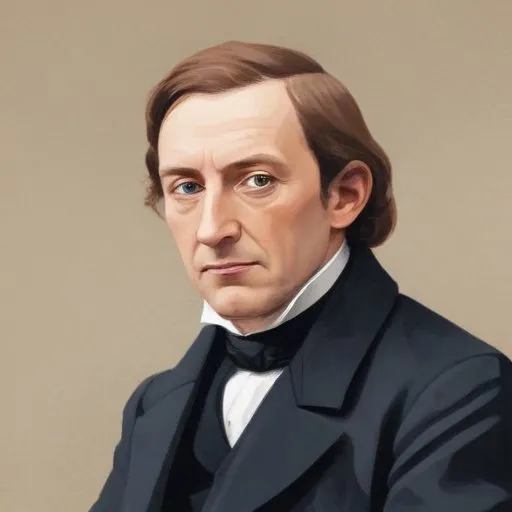
A 19th-century philosopher and literary critic who wrote extensively on ethics, metaphysics, and aesthetics, and is best known for editing the ninth edition of the Encyclopedia Britannica.
Thomas Spencer Baynes was a renowned English philosopher, editor, and educator, best known for his contributions to the field of philosophy, particularly in the study of Shakespeare, and his role as the first English-born editor of the Encyclopædia Britannica.
Born on March 24, 1823, in Wellington, Somerset, Baynes was the son of a Baptist minister. He intended to follow in his father's footsteps and study for the Baptist ministry, but his fascination with philosophical studies led him to abandon this path.
Baynes pursued his passion for philosophy at the University of Edinburgh, where he became the favorite pupil of Sir William Hamilton, a prominent Scottish philosopher. Under Hamilton's guidance, Baynes developed a deep understanding of philosophical systems and became an adherent of Hamilton's philosophical views.
Baynes began his career as an editor of a newspaper in Edinburgh, but his health issues forced him to take a break. He resumed his journalistic work in 1858 as an assistant editor of the Daily News. This experience laid the foundation for his future roles as a writer, editor, and educator.
In 1864, Baynes was appointed Professor of Logic and English Literature at St. Andrews University. During his tenure, he developed a keen interest in Shakespeare's works, which led to the publication of his valuable papers on the Bard's vocabulary and the extent of his learning. These papers were later collected and published as Shakespeare Studies.
In 1873, Baynes was appointed to superintend the ninth edition of the Encyclopædia Britannica, a monumental task that he undertook with gusto. He was the first English-born editor of the Britannica, and his work on this project cemented his reputation as a scholar and educator.
Baynes' philosophical views were shaped by his studies under Sir William Hamilton. He was a strong adherent of Hamilton's philosophical system, which emphasized the importance of intuition and common sense in understanding the world.
Baynes' own philosophical contributions focused on the study of language and literature. His work on Shakespeare's vocabulary and the extent of his learning showcased his expertise in linguistics and literary analysis.
Thomas Spencer Baynes' legacy extends beyond his academic achievements. His contributions to the field of philosophy, education, and literature have had a lasting impact on modern society.
As the first English-born editor of the Encyclopædia Britannica, Baynes played a crucial role in shaping the publication's direction and scope. His work on this project helped to establish the Britannica as a trusted authority on knowledge and education.
Beyond his academic achievements, Baynes' legacy lies in his ability to inspire and educate future generations of scholars and thinkers.
Through his remarkable life and career, Thomas Spencer Baynes left an indelible mark on the world of philosophy, education, and literature.
Born in 1806
A prominent 19th-century thinker who championed individual liberty, free speech, and women's rights, and is best known for his influential book "On Liberty".
Born in 1820
A pioneering thinker who coined the phrase "survival of the fittest" and applied evolutionary principles to social sciences, shaping modern sociology and philosophy.
Born in 1838
A pioneering utilitarian philosopher and economist who developed influential theories on ethics, morality, and welfare economics, shaping modern thought on these subjects.
Born in 1819
A prominent art critic and social reformer who championed the Pre-Raphaelite movement and advocated for social justice, leaving a lasting impact on art, architecture, and literature.
Born in 1822
A prominent Victorian-era poet and cultural critic, known for his influential essays on literature and society, which helped shape the modern concept of culture and its role in society.
Born in 1795
A 19th-century historian, philosopher, and academic who wrote influential works on history, politics, and society, particularly "The French Revolution" and "On Heroes, Hero-Worship, and The Heroic in History".
Born in 1801
A leading figure in the Oxford Movement, he was a prominent theologian and philosopher who converted to Catholicism, influencing Christian thought and education. He's also known for his poetry and hymns.
Born in 1839
A renowned Victorian-era art and literary critic, known for his influential writings on aesthetics and the importance of individualism in art. His works continue to shape art historical discourse.
