


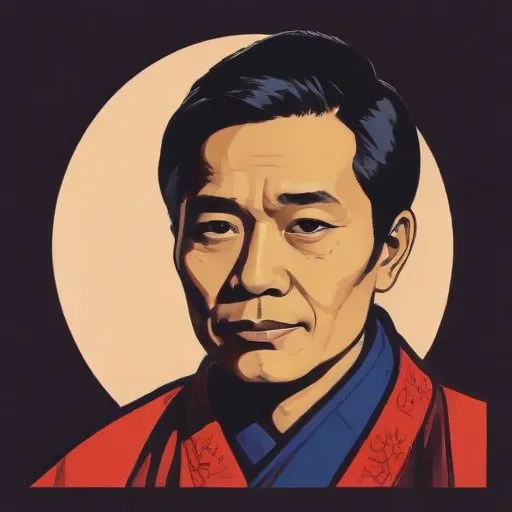
A pioneering figure in Chinese spoken drama, known for blending traditional and Western theatrical styles to create a unique form of Chinese opera.
Tian Han, a Chinese drama activist, playwright, and poet, is best known for writing the lyrics to the national anthem of the People's Republic of China, "March of the Volunteers". His contributions to Chinese spoken drama, revolutionary music, and films have earned him a place among the three founders of Chinese spoken drama, alongside Ouyang Yuqian and Hong Shen.
Tian Han was born on March 12, 1898, in Changsha, Hunan Province, China. He was educated at the Tokyo Higher Normal School (present-day University of Tsukuba) in Japan, where he developed a passion for drama and poetry.
Upon his return to China in 1921, Tian co-founded the Creation Society with Guo Moruo and Yu Dafu, a group of Chinese intellectuals who sought to promote artistic and literary reform. He also established the Southern China Society, which played a leading role in promoting dramatic performances in southern China.
Tian was a strong advocate for anti-imperialism and anti-feudalism, reflecting his involvement in the May Fourth Movement in 1919. His works often expressed his desire for social reform and his commitment to the ideals of the Chinese Revolution.
Tian taught at the Department of Literature of Shanghai Art University in 1927 and later joined The League of Chinese Left-Wing Dramatists. However, during the Cultural Revolution, he was targeted by the Gang of Four and attacked, leading to his imprisonment for two years until his death in 1968.
Tian Han's contributions to Chinese spoken drama, revolutionary music, and films have had a lasting impact on Chinese art and culture. His patriotic poem, "March of the Volunteers", continues to inspire generations of Chinese citizens. In 1979, he was posthumously rehabilitated by the Chinese authorities, acknowledging his significant role in shaping China's cultural identity.
Tian used various aliases, including Tin Shuchng, Bhng, Chn Y, Shrn, and Hnxin, reflecting his complex and multifaceted personality. Despite facing persecution during the Cultural Revolution, Tian remained committed to his artistic vision and continued to produce works that reflected his passion for social reform and national pride.
"The power of art lies not in its ability to reflect reality, but in its ability to create a new reality."
Tian Han's life and works continue to inspire generations of Chinese artists, writers, and intellectuals, cementing his place as one of the most influential figures in Chinese cultural history.
Born in 1009
A renowned poet and essayist of the Song Dynasty, known for his lyrical and expressive writings that explored themes of nature, politics, and human emotions.
Born in 1892
A prominent Chinese intellectual who made significant contributions to the country's cultural and literary heritage through his historical writings, poetry, and plays. He's also known for his role in shaping modern Chinese literature and language.
Born in 1896
A pioneering Chinese writer and critic, known for his influential literary works that explored the country's social and political landscape, particularly during the Republican era.
Born in 1868
A pioneering educator and reformer who transformed China's education system and promoted academic freedom, known for his advocacy of democracy and human rights.
