


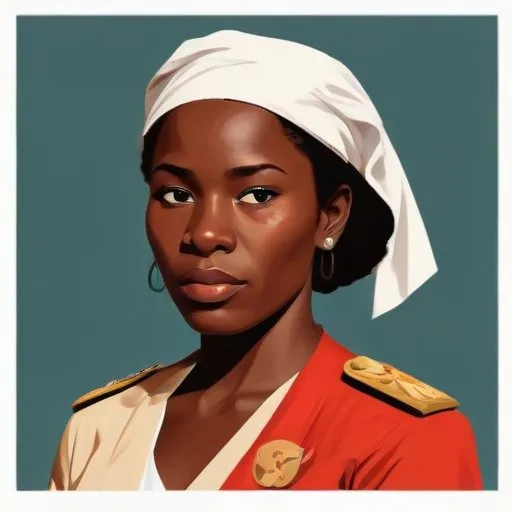
A pioneering female fighter in Guinea-Bissau's war for independence, leading troops and inspiring others to join the struggle against colonial rule.
Titina Sil, a name etched in the annals of Guinea-Bissau's history, is revered as a revolutionary icon who fought valiantly for the country's independence from the Portuguese Empire. As one of the first women to join the African Party for the Independence of Guinea and Cape Verde (PAIGC), she played a pivotal role in the Guinea-Bissau War of Independence, ultimately sacrificing her life for the cause.
Born on April 1, 1943, in the village of Cadique Betna, Tombali Region, Portuguese Guinea, Sil's early life was marked by her mother's strong influence. However, it was her encounter with Joo Bernardo Vieira, a mobilizer of the anticolonial movement, that set her on the path to revolution. Recruited into the PAIGC in 1962, Sil became one of the party's first female members, tasked with distributing illegal literature and liaising between mobilizers and the local peasantry.
Sil's conviction and determination quickly earned her recognition within the PAIGC. Despite her mother's initial disapproval, Sil convinced many to support or join the party. Her influence extended to the guerrilla forces in Cubucar, where she eventually ran away from home to join the fight. This bold move solidified her position as a prominent figure in the revolutionary movement.
Sil's training in nursing in the Soviet Union further equipped her for the challenges ahead. Upon her return, she assumed a commanding role in the Northern Front of the war, rising to the rank of political commissar and joining the Superior Council of the Revolutionary Armed Forces of the People (FARP). Her leadership and sacrifice inspired many, earning her praise from PAIGC leader Amlcar Cabral himself.
Tragically, Sil's life was cut short on January 30, 1973, when she was ambushed and killed by the Portuguese while en route to attend Cabral's funeral. Her martyrdom cemented her status as a national hero, and her legacy continues to inspire generations of Guineans. Today, January 30 is celebrated as National Women's Day in Guinea-Bissau, a testament to Sil's pioneering spirit and unwavering dedication to the fight for independence.
Titina Sil's sacrifice has been commemorated through various memorial dedications, solidifying her position as a symbol of gender equality and resistance against oppression. Her story serves as a powerful inspiration, educating young men and women about the importance of equality and the value of sacrifice in the pursuit of freedom.
Titina Sil's remarkable journey serves as a beacon of hope and resistance, inspiring generations to come. Her unwavering dedication to the cause of independence and her pioneering spirit continue to echo throughout Guinea-Bissau, solidifying her place in the annals of African history.
Born in 1924
African revolutionary and founder of Guinea-Bissau, leading the country to independence from Portugal through a decade-long guerrilla war. He's revered for his pan-Africanist vision and anti-colonial leadership.
Born in 1922
Angola's first president and a celebrated poet, he led the country to independence from Portugal and is revered for his nationalistic and literary contributions.
93 Years Old
Led Mozambique to independence from Portugal in 1975 and served as its first president, implementing socialist policies and promoting African unity. He's also known for his role in the fight against apartheid in South Africa.
87 Years Old
Led Mozambique to independence from Portugal in 1975 and served as its president from 1986 to 2004, implementing economic reforms and promoting regional stability.
Born in 1924
The 2nd President of Zimbabwe, a controversial figure who ruled with an iron fist, known for his country's economic downfall and human rights abuses.
