


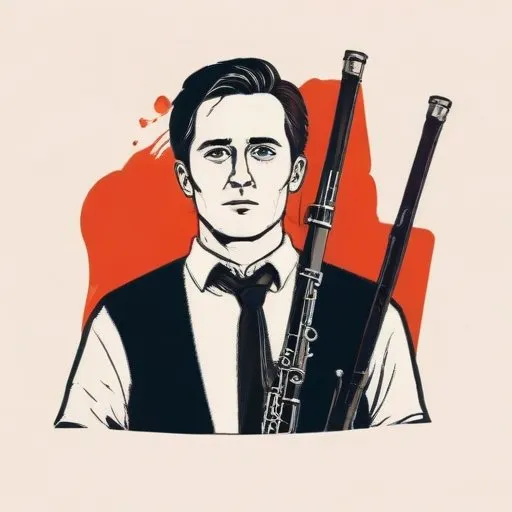
A Russian bassoon virtuoso and composer, known for his symphonic works and chamber music that showcased his instrument's expressive qualities. His music is characterized by lyricism and Russian folk influences.
Vasily Kalinnikov, a Russian composer, left an indelible mark on the world of classical music with his two symphonies, numerous songs, and orchestral works that resonate with the essence of folksong. His musical style, characterized by expressive melodies and lush orchestration, has been compared to the likes of Tchaikovsky and Rimsky-Korsakov, two giants of Russian music.
Born on January 1, 1866, in Oryol, Russia, Kalinnikov grew up in a family of modest means, his father being a police official. Despite the financial constraints, Kalinnikov's love for music drove him to pursue his passion. He began his musical journey at the seminary in Oryol, where he became the director of the choir at the tender age of 14. Later, he moved to the Moscow Conservatory, but unfortunately, he couldn't afford the tuition fees. However, his talent earned him a scholarship to attend the Moscow Philharmonic Society School, where he received lessons in bassoon and composition from Alexander Ilyinsky.
Kalinnikov's big break came in 1892 when Pyotr Ilyich Tchaikovsky recommended him for the position of main conductor of the Maly Theatre and later the Moscow Italian Theatre. However, his health started to deteriorate due to tuberculosis, a disease that would eventually claim his life. Owing to his worsening condition, Kalinnikov had to relinquish his theatre appointments and relocate to the warmer climate of Crimea, where he lived in Yalta for the remainder of his life.
During his time in Yalta, Kalinnikov wrote some of his most remarkable works, including his two symphonies and the incidental music for Alexey Tolstoy's Tsar Boris. The southern climate and picturesque surroundings seemed to inspire his creativity, despite his declining health. It's fascinating to note that Kalinnikov was not alone in Yalta; he was joined by two other famous tubercular patients, Maxim Gorky and Anton Chekhov.
Kalinnikov's untimely death on January 11, 1901, at the age of 34, was a tragic loss to the world of music. Despite his short life, he left behind a rich legacy of compositions that continue to enthrall audiences today. His symphonies, particularly the First, were frequently performed in the early 20th century, and his music has been praised for its lyricism and expressive qualities.
Today, Kalinnikov's music is a testament to his talent, perseverance, and dedication to his craft. His story serves as an inspiration to artists and musicians worldwide, reminding us that even in the face of adversity, creativity can thrive and leave an indelible mark on the world.
Kalinnikov's music is a testament to his passion, creativity, and resilience in the face of adversity. His legacy continues to inspire and captivate audiences, ensuring that his melodies and harmonies will echo beyond his time.
Born in 1840
A renowned Russian composer and educator, he is best known for his iconic and beloved ballets, such as Swan Lake and The Nutcracker, which continue to enchant audiences worldwide.
Born in 1829
A renowned Russian musician of the Romantic era, celebrated for his virtuosic piano performances and compositions that blended Russian folk elements with Western classical music traditions.
Born in 1844
A Russian master of orchestration, known for his vibrant and exotic compositions, such as "Scheherazade" and "Flight of the Bumblebee", that evoke fantastical worlds and mythical creatures.
Born in 1804
A Russian composer who is often considered the father of Russian classical music, known for his operas and orchestral works that blended Russian folk melodies with Western classical music traditions.
Born in 1839
A Russian master of evocative and dramatic music, famous for his vivid orchestral works, including the iconic "Night on Bald Mountain" and "Pictures at an Exhibition".
Born in 1833
A Russian mastermind who composed iconic symphonies and operas, while also making significant contributions to organic chemistry, synthesizing new compounds and discovering chemical reactions.
Born in 1824
A prominent Russian art critic and historian, known for his influential writings on Russian art, literature, and music, particularly in promoting the works of The Five composers.
Born in 1835
A Russian general, composer, and critic who made significant contributions to the development of Russian opera and music criticism, known for his innovative and eclectic compositions.
