


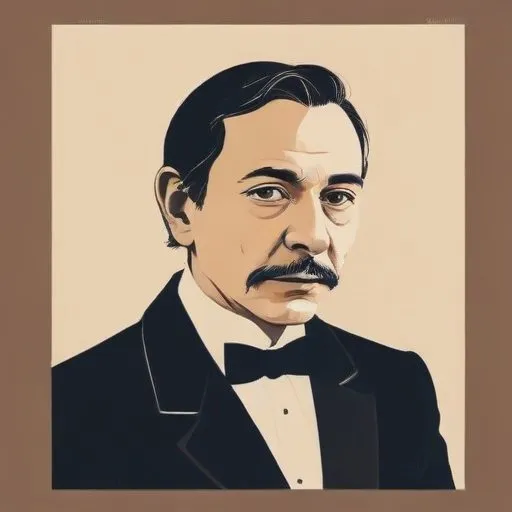
A renowned Russian musician who excelled as a pianist, composer, and conductor, leaving a lasting legacy in the classical music world through his performances and compositions.
Vasily Ilyich Safonov, also known as Wassily Safonoff, was a renowned Russian pianist, teacher, conductor, and composer who left an indelible mark on the world of music. Born on February 6, 1852, in Ishcherskaya, Russian Caucasus (now in Chechnya), Safonov's exceptional talent and dedication to his craft earned him a revered position among his contemporaries.
Safonov's journey in music began at an early age, and he went on to attend the Imperial Alexandra Lyceum in Saint Petersburg. He further honed his skills at the Saint Petersburg Conservatory of Music, where he studied under the guidance of Louis Brassin, Theodor Leschetizky, and Nikolai Zaremba. This extensive training earned him a gold medal as a pianist and a Bachelor of Laws degree.
Safonov's greatest contribution to the world of music was his work as an educator. He became the director of the Moscow Conservatory in 1889 and later took on the role of director at the National Conservatory of Music in New York. It was during this period that he mentored some of the most talented Russian pianists, including Alexander Scriabin, Nikolai Medtner, Josef Lhvinne, and Rosina Bessie Lhvinne.
His students revered him for his exceptional teaching methods, which emphasized the importance of technical mastery and emotional connection with the music. Safonov's ability to nurture talent and inspire his students is a testament to his dedication to the craft.
After retiring from teaching, Safonov turned his attention to conducting, where he demonstrated his exceptional skill and passion. One of his most notable performances was the first Moscow rendition of Tchaikovsky's Pathtique Symphony No. 6, which took place on December 16, 1893, just seven weeks after its premiere.
Safonov's personal life was marked by the tragic events that befell his family. His daughter, Anna Vasilyevna Timiryova, was a poet who spent much of her life in labor camps or exile. His other daughters, Varvara Vasilievna Safonova and Yelena Vasilievna Safonova, were also artists, but met with similar fates.
Despite the challenges he faced, Safonov remained committed to his art, leaving behind a legacy that continues to inspire generations of musicians. His contributions to the world of music are a testament to his unwavering dedication and passion.
"Music is not only a profession, but a calling."
"A true artist must always remain a student."
Born in 1873
A renowned Russian musician who composed iconic symphonies and piano concertos, and was also a skilled pianist and conductor, leaving a lasting legacy in classical music.
Born in 1840
A renowned Russian composer and educator, he is best known for his iconic and beloved ballets, such as Swan Lake and The Nutcracker, which continue to enchant audiences worldwide.
Born in 1839
A Russian master of evocative and dramatic music, famous for his vivid orchestral works, including the iconic "Night on Bald Mountain" and "Pictures at an Exhibition".
Born in 1844
A Russian master of orchestration, known for his vibrant and exotic compositions, such as "Scheherazade" and "Flight of the Bumblebee", that evoke fantastical worlds and mythical creatures.
Born in 1829
A renowned Russian musician of the Romantic era, celebrated for his virtuosic piano performances and compositions that blended Russian folk elements with Western classical music traditions.
Born in 1837
A Russian pianist and composer who founded the Mighty Handful, a group of composers who sought to create a distinctly Russian style of classical music, known for his orchestral works and piano pieces.
Born in 1835
A Russian general, composer, and critic who made significant contributions to the development of Russian opera and music criticism, known for his innovative and eclectic compositions.
Born in 1833
A Russian mastermind who composed iconic symphonies and operas, while also making significant contributions to organic chemistry, synthesizing new compounds and discovering chemical reactions.
