


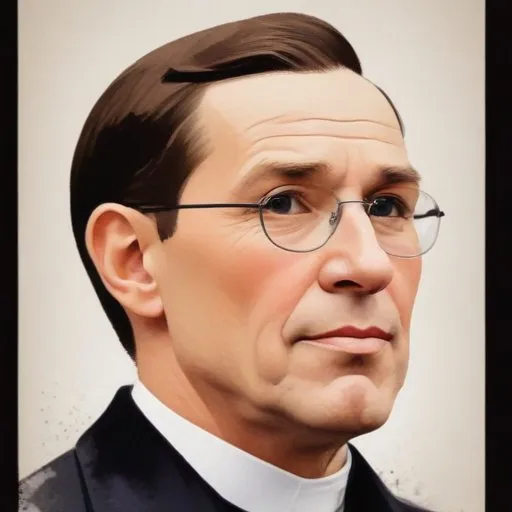
A pioneering figure in the Social Gospel movement, advocating for Christianity to address social injustices and poverty, and authoring influential works like "Christianity and the Social Crisis".
If you're familiar with the concept of Social Gospel, chances are you've heard of Walter Rauschenbusch, the American theologian and Baptist pastor who crusaded for social justice and equality in the early 20th century. As a pioneer of the Social Gospel movement, Rauschenbusch's work inspired a generation of Christians to take action against poverty, inequality, and exploitation.
Born on October 4, 1861, in Rochester, New York, to German parents Augustus Rauschenbusch and Caroline Rump, Walter underwent a transformative experience at the age of 17, when he had a personal religious conversion. This turning point led him to pray for help and seek guidance, but he soon realized that his faith was incomplete, focusing on personal sins rather than social ones.
Rauschenbusch's educational journey took him to Germany, where he studied in a gymnasium equivalent to a preparatory school in Gütersloh. He later returned to the United States and earned a Bachelor of Arts from the University of Rochester in 1884. Subsequently, he pursued theological studies at the Rochester Theological Seminary, graduating with a Bachelor of Divinity in 1886.
In 1886, Rauschenbusch began his ministerial career, which would span over three decades. He served as a pastor in New York City's Hell's Kitchen, where he witnessed firsthand the harsh realities of urban poverty and inequality. This experience solidified his conviction that Christianity must engage with social issues and advocate for justice.
Rauschenbusch's seminal work, Christianity and the Social Crisis (1907), is considered a landmark in the development of the Social Gospel movement. In it, he argued that Christianity must address the social and economic problems of the time, rather than focusing solely on individual salvation. This book, along with his other influential works, such as Christianizing the Social Order (1912) and The Social Principles of Jesus (1916), cemented his reputation as a leading voice in the Social Gospel movement.
Walter Rauschenbusch's legacy extends far beyond his own lifetime. He inspired a generation of Christian activists, including notable figures like Martin Luther King Jr., who credited Rauschenbusch as an influence. Today, his commitment to social justice and equality continues to inspire religious and secular leaders alike, ensuring that his message of compassion and justice remains relevant and vital.
Rauschenbusch's family life was marked by significant relationships and events. He was married to Pauline Rother, and the couple had five children together. His maternal grandson, Richard Rorty, would go on to become a renowned philosopher, and his great-grandson, Paul Raushenbush, is a prominent writer and activist.
Rauschenbusch's groundbreaking work in the Social Gospel movement has had a lasting impact on modern society. His emphasis on social justice, equality, and collective action has influenced progressive movements, from the Civil Rights Movement to contemporary struggles for environmental justice and economic equality.
Walter Rauschenbusch's life and work serve as a powerful reminder that faith and social action are intertwined. As we continue to grapple with the challenges of our time, his legacy inspires us to strive for a more just and compassionate world.
Born in 1892
A prominent mid-20th-century theologian and academic who developed the concept of "Christian realism," which emphasizes the role of sin and self-interest in human nature, influencing modern political and social thought.
Born in 1906
A German pastor and theologian who resisted the Nazi regime, writing influential books on faith and ethics, and ultimately giving his life for his convictions.
Born in 1886
A 20th-century theologian who redefined Christian doctrine with his emphasis on God's revelation and humanity's sinful nature, influencing modern Christian thought.
Born in 1483
A German monk and priest who sparked the Protestant Reformation, challenging Catholic Church authority and shaping Western Christianity. He's famous for nailing 95 theses to a church door, sparking a religious revolution.
Born in 1509
A French pastor and theologian who played a key role in the Protestant Reformation, shaping Christian theology and influencing Western civilization. He's famous for his teachings on predestination and his role in establishing Calvinism.
60 Years Old
A British athlete who won gold at the 2000 Sydney Olympics and held the world triple jump record from 1995 to 2011, earning him a place in the UK Athletics Hall of Fame.
95 Years Old
A legendary promoter who revolutionized the music industry by organizing iconic concerts and festivals, such as Woodstock and the Fillmore, shaping the cultural landscape of the 1960s.
97 Years Old
A prominent leader in the civil rights movement, advocating for racial equality and social justice through nonviolent means, leaving a lasting impact on American history.
