


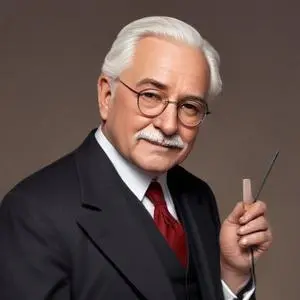
A prominent figure in American literary realism, known for his novels and plays that explored the lives of ordinary people, and his influential literary criticism.
William Dean Howells is renowned as one of the most influential American realist novelists, literary critics, and playwrights of the late 19th and early 20th centuries. He is particularly notable for his tenure as editor of The Atlantic Monthly, as well as for his novels The Rise of Silas Lapham and A Traveler from Altruria, and the Christmas story Christmas Every Day, which was adapted into a 1996 film of the same name.
Howells was born on March 1, 1837, in Martinsville, Ohio (now known as Martins Ferry, Ohio), to William Cooper Howells and Mary Dean Howells. He was the second of eight children, with Welsh, German, Irish, and English ancestry. His father, a newspaper editor and printer, moved frequently around Ohio, and the family had to live frugally. Despite the challenges, Howells' parents encouraged his literary interests, and he began helping his father with typesetting and printing work at an early age.
In 1856, Howells was elected as a clerk in the State House of Representatives. Two years later, he began working at the Ohio State Journal, where he wrote poetry and short stories, and also translated pieces from French, Spanish, and German. During this period, he developed a deep interest in the works of Heinrich Heine and avidly studied German and other languages.
In 1860, Howells visited Boston, Massachusetts, where he met with prominent writers such as James T. Fields, James Russell Lowell, Oliver Wendell Holmes Sr., Nathaniel Hawthorne, Henry David Thoreau, and Ralph Waldo Emerson. He formed lasting friendships with many of them, including Henry Adams, William James, Henry James, and Oliver Wendell Holmes Sr.
Howells' literary prowess earned him the position of editor at The Atlantic Monthly, a role he held from 1871 to 1881. During his tenure, he fostered a platform for realist writers, publishing works by Mark Twain, Henry James, and Hamlin Garland, among others. He also contributed to the magazine himself, publishing numerous essays, reviews, and short stories.
Howells was a proponent of realist literature, which sought to depict life accurately and truthfully. He believed that literature should reflect the complexities and nuances of human experience, rather than romanticizing or idealizing it. His advocacy for realism helped shape the literary landscape of the late 19th century, influencing a generation of American writers.
Howells' influence on American literature cannot be overstated. He played a pivotal role in shaping the country's literary identity, fostering a new generation of writers, and promoting the ideals of realism. His own works, though sometimes overlooked in favor of those of his contemporaries, continue to offer valuable insights into the human condition and the complexities of American society.
Howells married Elinor Mead in 1862, and the couple had three children. He was known for his kind and generous nature, and was beloved by his friends and family. Despite personal struggles, including the loss of his daughter Winifred in 1889, Howells remained committed to his craft, continuing to write until his death on May 11, 1920.
Howells' life and work spanned a period of significant change and upheaval in American history, from the Civil War to the early 20th century. His writing reflects the country's ongoing struggles with identity, morality, and social justice, offering a unique window into the complexities of the American experience. Today, Howells is remembered as a champion of literature, a devoted friend and mentor, and a tireless advocate for the power of storytelling to shape our understanding of the world.
Born in 1835
Witty writer of classics like "The Adventures of Tom Sawyer" and "The Adventures of Huckleberry Finn", known for humor and social commentary.
Born in 1843
A renowned literary mastermind, celebrated for crafting psychologically complex, atmospheric novels and short stories that probed the human condition, often exploring the intricacies of the American and European aristocracy.
Born in 1862
A pioneering female author of novels and short stories that explored the social conventions and morals of the Gilded Age, known for her witty and insightful portrayals of the American aristocracy.
Born in 1871
A pioneering realist writer who chronicled the lives of the American working class, capturing the gritty realities of urban existence through novels like "Sister Carrie" and "An American Tragedy".
Born in 1870
Pioneering naturalist writer who explored the darker aspects of human nature and the American Dream through novels like "McTeague" and "The Octopus".
Born in 1878
A pioneering muckraker, exposing social and economic injustices through influential novels, most notably "The Jungle", which led to significant reforms in the meatpacking industry.
Born in 1869
Pulitzer Prize-winning author of nostalgic and humorous novels about American life, particularly in the Midwest during the early 20th century.
Born in 1899
A legendary writer who crafted sparse, powerful prose, capturing the human experience in novels like "The Old Man and the Sea" and "A Farewell to Arms".
