


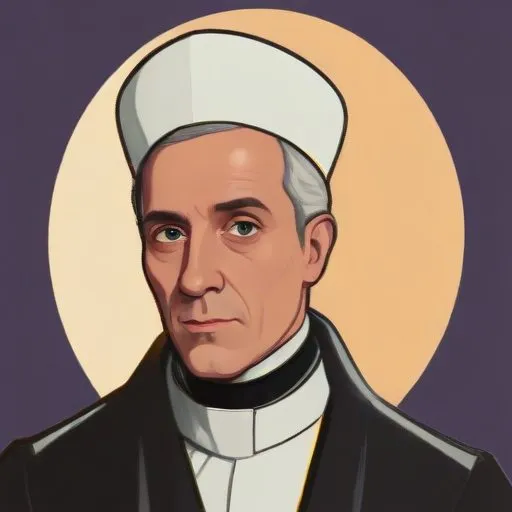
Founded the Society of Mary, a Catholic religious order focused on education and mission work, known for their emphasis on community and Marian devotion.
William Joseph Chaminade, a French Catholic priest, is renowned for his unwavering dedication to his faith and his role in founding the Society of Mary, also known as the Marianists, in 1817. Through his remarkable journey, he demonstrated extraordinary courage and perseverance, inspiring generations to come.
Born on April 8, 1761, in Prigueux, France, Chaminade was the 14th child of deeply religious parents, Catherine Bethon and Blaise Chaminade. From a young age, he felt an inexplicable calling to serve the Lord, and at the tender age of ten, he entered a minor seminary in Mussidan.
Chaminade's family nurtured his spiritual growth, with three of his brothers becoming priests. He was ordained a priest in 1785 for the local diocese, embarking on a path that would lead him to become a champion of faith in the face of adversity.
In 1790, following the outbreak of the French Revolution, Chaminade relocated to Bordeaux, where he became an unlikely enemy of the state. By refusing to take the Civil Constitution of the Clergy oath, he risked execution, opting instead to secretly continue his priestly duties.
During this tumultuous period, Chaminade found an ally in Marie-Thérèse Charlotte de Lamourous, with whom he collaborated to establish Bordeaux's Miséricorde House of Mercy, a sanctuary for fallen women. This act of compassion and defiance in the face of persecution would become a hallmark of his remarkable life.
In 1817, Chaminade founded the Society of Mary, a congregation that would become a beacon of hope for countless individuals. The Marianists, as they came to be known, were dedicated to spreading the message of God's love and fostering a deep devotion to Mary, the Mother of Jesus.
This remarkable accomplishment was not without its challenges, as Chaminade faced numerous obstacles in his quest to establish the Society. Despite these hurdles, he persevered, driven by an unwavering conviction in his mission.
On September 3, 2000, Pope John Paul II recognized Chaminade's extraordinary life and work by beatifying him, a testament to his enduring impact on the Catholic Church.
Chaminade's feast day, celebrated on January 22, serves as a poignant reminder of his remarkable life and the profound influence he has had on generations of devotees.
The Marianist Family, comprising the Society of Mary, the Daughters of Mary Immaculate, the Marianist Lay Communities, and the Alliance Mariale, looks to Chaminade as a founder and inspiration. His unwavering commitment to his faith has inspired countless men and women to follow in his footsteps, spreading God's love and kindness throughout the world.
William Joseph Chaminade's extraordinary life serves as a shining example of courage, perseverance, and devotion, leaving an indelible mark on the world. His remarkable story continues to inspire, motivating individuals to emulate his selflessness and compassion.
Born in 1876
The leader of the Catholic Church from 1939 to 1958, known for his controversial role during World War II, particularly in regards to the Holocaust. He is also remembered for his encyclicals on social justice and liturgical reforms.
Born in 1810
The first pope to fully embrace modernity, he issued the groundbreaking encyclical Rerum Novarum, which addressed social justice and workers' rights, shaping the Catholic Church's stance on social issues.
Born in 1742
The head of the Catholic Church from 1800 to 1823, known for his opposition to Napoleon Bonaparte and his restoration of the Papal States.
Born in 1554
Established the Congregation for the Propagation of the Faith, a missionary organization that aimed to spread Catholicism globally, and standardized the papal conclave process.
Born in 1499
Reigned from 1559 to 1565, this Pope oversaw the final session of the Council of Trent, shaping Catholic doctrine and practice for centuries to come. He also commissioned the construction of the Sistine Chapel's dome.
Born in 1810
The first pope to fully embrace modernity, he issued the groundbreaking encyclical Rerum Novarum, which addressed social justice and workers' rights, shaping the Catholic Church's stance on social issues.
Born in 1504
Leader of the Catholic Church during the Counter-Reformation, he excommunicated Queen Elizabeth I and played a key role in the Council of Trent.
Born in 1675
A 18th-century pope who reformed the Catholic Church, promoting tolerance and scholarship, and is known for his encyclicals on topics like usury and the sacraments.
