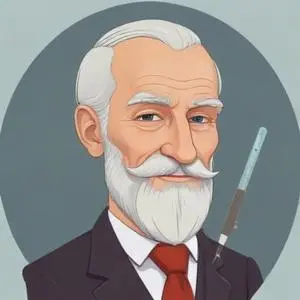
William Thomson, 1st Baron Kelvin: The Visionary Physicist Who Transformed Our Understanding of the Universe
A Legacy of Innovation and Discovery
William Thomson, 1st Baron Kelvin, was a Scottish-Irish physicist and mathematician who revolutionized our understanding of the physical world. Born on June 26, 1824, in Belfast, Ireland, Kelvin's groundbreaking work in the fields of thermodynamics, electromagnetism, and mathematical physics earned him widespread recognition and acclaim.
Early Life and Education
Kelvin's fascination with mathematics and science began at a young age, and he entered the University of Glasgow at just 10 years old. He later attended Cambridge University, where he graduated in 1845 with a degree in mathematics. It was during his time at Cambridge that Kelvin developed a deep interest in the works of French mathematician and physicist, Simeon Poisson, which would later influence his own research.
Major Contributions and Discoveries
Kelvin's most significant contribution to science was his work on the second law of thermodynamics, which he formulated in the 1850s. This law, which states that energy cannot be created or destroyed, only converted from one form to another, laid the foundation for modern thermodynamics and had far-reaching implications for fields such as engineering and physics.
In addition to his work on thermodynamics, Kelvin made significant contributions to the field of electromagnetism, including the discovery of the Kelvin-Helmholtz instability, which occurs when two fluids of different densities and velocities meet. He also developed the Kelvin-Stokes theorem, a fundamental concept in vector calculus.
Philosophical Contributions and Beliefs
Kelvin's work was not limited to scientific inquiry alone. He was also a vocal advocate for the importance of religion and morality in scientific pursuits. He believed that science and faith were not mutually exclusive, but rather complementary ways of understanding the world.
Personal Milestones and Key Life Events
Kelvin's personal life was marked by significant milestones and achievements. In 1852, he married Margaret Crum, with whom he had two daughters. He was knighted in 1866 for his contributions to science, and in 1892, he was elevated to the peerage as Baron Kelvin of Largs.
Influence on Modern Society
Kelvin's work had a profound impact on modern society. His discovery of the second law of thermodynamics led to the development of more efficient engines and refrigeration systems, which in turn revolutionized industries such as transportation and agriculture. His work on electromagnetism paved the way for the development of modern technologies such as radio communication and radar.
Quotes and Memorable Sayings
Kelvin was known for his wit and wisdom, and his quotes continue to inspire scientists and thinkers to this day. One of his most famous quotes is: "If you can't measure it, you can't improve it," which reflects his emphasis on the importance of empirical evidence in scientific inquiry.
Historical Context and Legacy
Kelvin's work took place during a time of great scientific and technological change. He was a contemporary of other notable scientists such as
Charles Darwin and
James Clerk Maxwell, and his work built upon and contributed to the discoveries of his peers. Today, Kelvin is remembered as one of the most influential scientists of the 19th century, and his work continues to shape our understanding of the universe.
Career Highlights and Major Works
- Treatise on Natural Philosophy (1867) - a comprehensive work on the principles of physics
- Baltimore Lectures on Molecular Dynamics and the Wave Theory of Light (1904) - a collection of lectures delivered at Johns Hopkins University
- (1882-1911) - a collection of Kelvin's scientific papers and articles
Awards and Honors
Kelvin's many awards and honors include:
- Royal Medal (1856)
- Copley Medal (1883)
- Oxford University's Honorary Doctor of Laws (1867)
Visual Timeline and Milestones
1824 - Born in Belfast, Ireland
1845 - Graduated from Cambridge University with a degree in mathematics
1850s - Formulated the second law of thermodynamics
1866 - Knighted for his contributions to science
1892 - Elevated to the peerage as Baron Kelvin of Largs
1907 - Died on December 17, 1907, at the age of 83
By exploring the life and work of William Thomson, 1st Baron Kelvin, we gain a deeper understanding of the complex and fascinating world of 19th-century science. His groundbreaking discoveries and contributions continue to inspire scientists and thinkers today, and his legacy remains a testament to the power of human ingenuity and curiosity.
FAQ
What were William Thomsons contributions to physics?
William Thomson, also known as Lord Kelvin, made significant contributions to physics, including the discovery of the Thomson effect and the development of the Kelvin scale. He was a pioneer in the field of thermodynamics.
What is the significance of William Thomsons work on thermodynamics?
William Thomsons work on thermodynamics laid the foundation for modern understandings of energy and temperature. His discoveries have had a lasting impact on fields such as engineering, chemistry, and materials science.
How did William Thomsons work influence the development of electricity?
William Thomsons research on electricity and magnetism helped establish the principles of electromagnetic induction. His work in this area paved the way for innovations in electrical engineering and technology.
What was William Thomsons role in the development of the Atlantic Telegraph Cable?
William Thomson played a crucial role in the development of the Atlantic Telegraph Cable, which enabled transatlantic communication. He worked on the mathematical calculations necessary for the cables design and implementation.
What honors did William Thomson receive for his scientific contributions?
William Thomson was knighted in 1866 and elevated to the peerage as Baron Kelvin in 1892. He received numerous accolades for his scientific contributions, including the Copley Medal and the Royal Medal.