


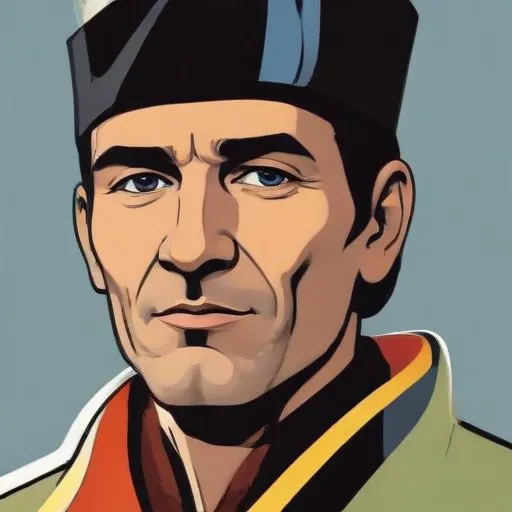
A 19th-century Polish nobleman and artist, known for his romanticist paintings and illustrations, particularly his portraits of Polish aristocracy and landscapes. His works are considered some of the most important in Polish art history.
Wincenty Krasiski, a Polish nobleman, political activist, and military leader, is best known for his bravery and unwavering dedication to the cause of Polish independence. As the father of Zygmunt Krasiski, one of Poland's Three Bards, Wincenty's influence extend beyond the realms of military leadership to the world of literature and poetry.
Wincenty's military career began at the tender age of eight in 1791 in the National Cavalry, where he quickly rose through the ranks to become a Lieutenant by the time he was just ten years old. Although this was more of a military school service than real combat experience, it laid the foundation for his future exploits as a brave and capable commander.
As the French Army occupied Prussian Poland, Wincenty saw an opportunity to fight for his country's freedom and created a cavalry squadron at his own expense. He went on to participate in Napoleon's campaigns from 1807 to 1814, distinguishing himself in numerous battles, including Wagram in 1809 and the Russian Campaign from 1812 to 1813.
In 1811, Wincenty was promoted to Brigadier General and in 1813, to Major General (Polish: gen. dywizji). He eventually became the commander of the 1st Polish Light Cavalry Regiment of the Imperial Guard, earning the respect and admiration of his comrades and the accolades of his enemies.
For his bravery and military prowess, Wincenty was awarded the Virtuti Militari in 1810 and the Légion d'honneur order in 1811. His exploits in the Napoleonic Wars cemented his reputation as a fearless and skilled commander, earning him the nickname "Vincent de Corvin-Krasinski" in France.
Following Napoleon's abdication, Wincenty became commander of a Guard Division in Russian-dominated Congress Poland in 1815. He went on to serve as General-Adjutant of the Czar and Sejm Marshal from 1818, earning the Order of the White Eagle in 1821.
However, his loyalty to the Czar was not without controversy. In 1828, as a member of the Sejm Court, Wincenty voted for the death penalty during the trial of activists from the Patriotic Society, earning him the criticism of public opinion and independence circles alike.
Despite the controversies that marred his later years, Wincenty Krasiski's contribution to the struggle for Polish independence remains unimpeachable. His bravery, military prowess, and unwavering dedication to the cause of Polish freedom have inspired generations of Poles and earned him a place in the annals of history.
Moreover, his legacy extends beyond the realm of military leadership to the world of literature and poetry, thanks to his son Zygmunt, one of Poland's Three Bards. Together, they represent a family that has given so much to the cultural and military heritage of Poland, their contributions a testament to the enduring power of patriotism and artistic expression.
Born in 1867
A Polish leader who played a crucial role in regaining Poland's independence after World War I and served as the country's prime minister, known for his military prowess and statesmanship.
Born in 1867
A Polish novelist who won the Nobel Prize in Literature in 1924 for his novel "Ch?opi" (The Peasants), a realistic depiction of rural life in Poland. He's known for his detailed and nuanced portrayals of Polish society and culture.
Born in 1846
A Polish journalist and author who wrote epic historical novels, including "Quo Vadis", which won him the Nobel Prize in Literature in 1905. His works are known for their vivid storytelling and historical accuracy.
Born in 1869
A Polish Renaissance man who excelled in poetry, playwriting, and painting, creating iconic works that merged folk motifs with modernist styles. His innovative art and literature continue to inspire Polish culture.
Born in 1758
A Belarusian-Polish poet, playwright, and politician who played a key role in the Polish national revival and is best known for his patriotic writings and involvement in the country's struggle for independence.
Born in 1798
A national hero in Poland, celebrated for his romantic poetry and plays that ignited a sense of patriotism and freedom during a time of foreign rule. His works are still widely read and performed today.
