


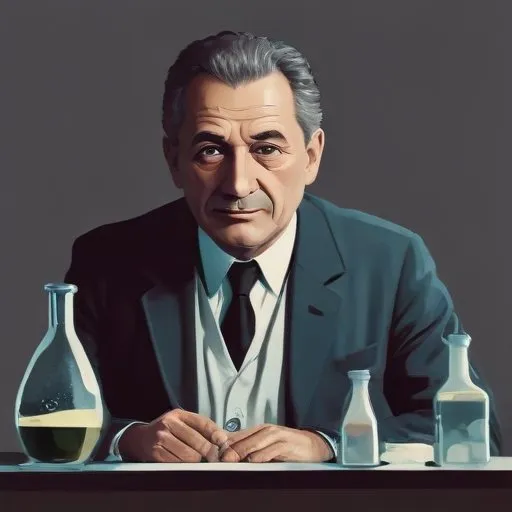
Developed a method for detecting life on Mars and made significant contributions to the field of astrobiology and exobiology. Known for his innovative approaches to searching for extraterrestrial life.
Wolf V. Vishniac, a renowned American microbiologist, is best known for his groundbreaking contributions to the search for life on Mars. His innovative approach and perseverance led to the development of a special miniature laboratory, aptly named the Wolf Trap, designed to detect life on the Red Planet.
Born on April 22, 1922, Wolf Vishniac was the son of Roman Vishniac, a famous photographer, and went on to become a prominent figure in the field of microbiology. Educated at Brooklyn College and Stanford University, Vishniac became a professor of biology at the University of Rochester, where he dedicated his life to understanding the mysteries of the Martian environment.
The Wolf Trap, a pioneering innovation in space exploration, was a portable laboratory designed to detect life on Mars. This ingenious device was the result of Vishniac's tireless efforts, supported by a NASA grant initiated in 1959, the first of its kind for the biological sciences. The Wolf Trap symbolized humanity's unwavering quest to uncover the secrets of the Red Planet.
Tragically, Wolf Vishniac's life was cut short on December 10, 1973, during a research trip to Antarctica. He died while attempting to retrieve equipment in a crevasse, leaving behind a legacy that would continue to inspire generations of scientists and explorers.
In recognition of Vishniac's outstanding contributions, the Wolf Vishniac Memorial Award was established to honor young researchers who demonstrate exceptional dedication and innovation in their field. Presented biennially at the International Symposium On Environmental Biogeochemistry (ISEB), this award serves as a testament to Vishniac's enduring impact on the scientific community.
Vishniac's remarkable story and achievements were immortalized in the 1980 television series Cosmos: A Personal Voyage, where Carl Sagan paid tribute to the microbiologist's pioneering spirit in Episode 5, "Blues for a Red Planet."
Vishniac's groundbreaking work not only expanded our understanding of the Martian environment but also paved the way for future generations of microbiologists. His legacy continues to inspire researchers to push the boundaries of human knowledge, driving us closer to unraveling the mysteries of the cosmos.
Wolf V. Vishniac's remarkable journey serves as a testament to the power of human curiosity and innovation. His contributions to the search for life on Mars continue to inspire and motivate scientists, ensuring that his legacy will endure for generations to come.
Born in 1856
Pioneering microbiologist and ecologist who discovered chemosynthesis, the process by which microorganisms thrive in extreme environments, and founded modern soil science. His work transformed our understanding of microbial life and ecosystems.
Born in 1851
Pioneering microbiologist and botanist who discovered viruses, developed enrichment culture techniques, and coined the term "virus" to describe these tiny infectious agents. Their work laid the foundation for modern virology and microbiology.
Born in 1881
Discovered penicillin, a revolutionary antibiotic, and pioneered its use in medicine. This breakthrough has saved countless lives and transformed the field of healthcare.
Born in 1888
A pioneering biochemist and microbiologist who discovered numerous antibiotics, including streptomycin, and developed a method for producing them on a large scale. Their work revolutionized the treatment of bacterial infections.
Born in 1901
A pioneer in microbiology and environmentalism, he explored the interconnectedness of humans and their ecosystem, advocating for a holistic approach to health and conservation.
Born in 1910
A French biochemist and geneticist who discovered the mechanism of gene regulation, earning a Nobel Prize in Physiology or Medicine in 1965. He's also known for his book "Chance and Necessity," which explores the philosophical implications of modern biology.
Born in 1920
A French biologist and geneticist who discovered the mechanism of gene regulation, pioneering the field of molecular biology. He won the Nobel Prize in Physiology or Medicine in 1965 for his work on the genetic control of enzyme synthesis.
Born in 1925
A pioneering geneticist who discovered bacterial gene recombination and transduction, revolutionizing our understanding of genetic inheritance and earning a Nobel Prize.
