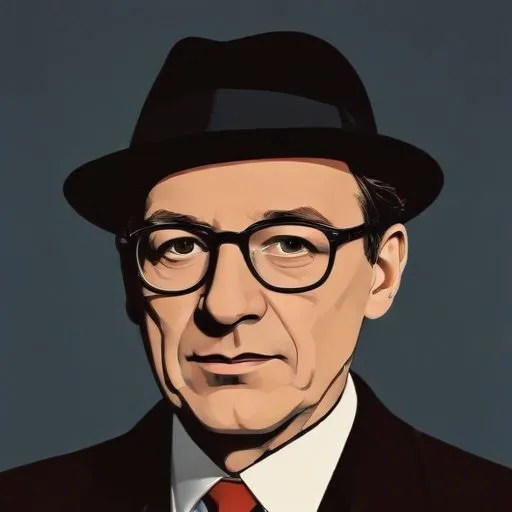
Wolfgang Leonhard: A Maverick Historian of Communism and the Soviet Union
Wolfgang Leonhard was a German political author and historian who dedicated his life to understanding and chronicling the complexities of the Soviet Union, the German Democratic Republic, and Communism. As a prominent figure who defected from East Germany to the West, Leonhard's unique perspective and extensive knowledge made him a sought-after expert in his field.
A Life of Contrasts: Early Years and Education
Born Vladimir Leonhard on April 16, 1921, in Vienna, Austria, Wolfgang was the son of writers Susanne Khler and Rudolf Leonhard. His mother, an active Communist, had been a close friend of renowned German Communist leaders
Rosa Luxemburg and
Karl Liebknecht. However, by the time of Wolfgang's birth, his parents were already divorced, and his mother had married the Soviet ambassador to Austria, Mieczysaw Broski, under Soviet law.
Leonhard's early years were marked by turmoil and instability. He attended the
Karl Marx Grammar School in Berlin and joined the Young Pioneers, the youth organization of the Communist Party of Germany. As the Nazi party rose to power in Germany, Leonhard's mother sent him to a private boarding school in Sweden in 1932, and later, in 1935, she visited him there but was unable to return to Germany due to her involvement with an anti-fascist group.
The Defection and the Dawn of a New Era
After World War II, Leonhard became one of the founders and leaders of the German Democratic Republic (GDR). However, he soon became disillusioned with the Communist regime and defected to Yugoslavia in 1949. He later moved to West Germany in 1950 and eventually settled in the United Kingdom. This marked the beginning of a new chapter in Leonhard's life, as he began to share his unique insights and experiences with the Western world.
A Professor's Odyssey: Teaching and Writing
In 1956, Leonhard emigrated to the United States, where he became a popular and influential professor at Yale University from 1966 to 1987. During this period, he taught the history of communism and the Soviet Union, drawing from his extensive knowledge and personal experiences. Leonhard's expertise made him a sought-after authority, and he wrote several books on the topics, cementing his reputation as a leading historian of communism.
Legacy and Impact
After the Cold War ended, Leonhard returned to Germany, where he continued to share his expertise and write about his area of specialization. His work has had a significant impact on the field of Soviet and Communist studies, and his legacy continues to inspire new generations of historians and scholars.
Leonhard's life was marked by contradictions – a Communist who defected to the West, a historian who wrote about the very system he once served. Yet, it was this unique perspective that enabled him to provide unparalleled insights into the complexities of communism and the Soviet Union.
"The Soviet system was a system of contradictions... It was a system that was ultra-centralized, and yet, at the same time, it was a system that was incredibly inefficient."
— Wolfgang Leonhard
Awards and Honors
Throughout his career, Leonhard received numerous awards and honors for his contributions to the field of Soviet and Communist studies. His work continues to be recognized and respected, and his legacy as a pioneering historian remains unmatched.
Personal Life and Milestones
Leonhard's personal life was marked by significant milestones, including his decision to defect from East Germany and his eventual settlement in the United States. His experiences during World War II and his time in the Soviet Union shaped his perspective and informed his work.
Philosophical Contributions and Beliefs
Leonhard's philosophical contributions centered around his nuanced understanding of communism and the Soviet Union. He believed that the system was inherently flawed, marked by inefficiencies and contradictions. His work highlighted the complexities of communist ideology and its practical applications.
Trivia and Fun Facts
- Leonhard's mother, Susanne Khler, was a close friend of Rosa Luxemburg and Karl Liebknecht, prominent German Communist leaders.
- Leonhard attended the Karl Marx Grammar School in Berlin as a young man.
- He was a professor at Yale University for over two decades, from 1966 to 1987.
Wolfgang Leonhard's remarkable life and work continue to inspire and educate new generations of scholars and historians. As a pioneering expert on communism and the Soviet Union, his legacy remains unparalleled.