


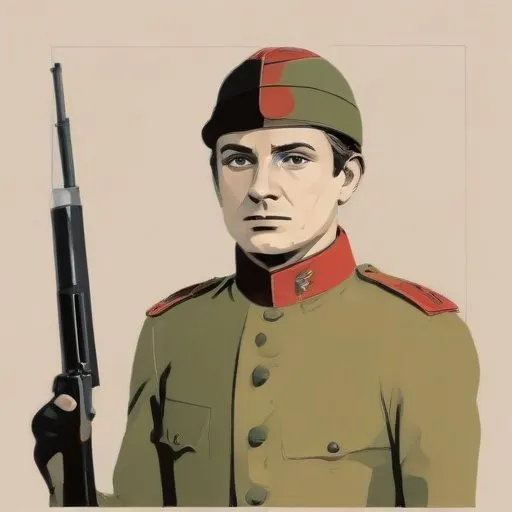
A French soldier, author, and critic who wrote the iconic coming-of-age novel "Le Grand Meaulnes", a poignant and dreamy portrayal of adolescence. He's celebrated for his lyrical prose and nostalgic storytelling.
Alain Fournier, the pseudonym of Henri Alban Fournier, is renowned for his poignant and thought-provoking novel Le Grand Meaulnes, a work that has been hailed as a classic of French literature. This seminal novel, published in 1913, is his only completed work, yet it has captivated readers for generations with its haunting and introspective portrayal of adolescence and the human experience.
Born on October 3, 1886, in La Chapelle-d'Angillon, in the Cher department of central France, Fournier was the son of a school teacher. His early life was marked by a deep love for literature and learning, which led him to study at the Lyce Lakanal in Sceaux, near Paris. It was during this period that he formed a close bond with his future brother-in-law, Jacques Rivière, who would later marry his sister, Isabelle.
In 1907, Fournier interrupted his studies to begin his military service, an experience that would profoundly impact his writing and worldview. During this time, he penned several essays, poems, and stories, which were later collected and published under the title Miracles. However, it was his novel, Le Grand Meaulnes, that would bring him lasting acclaim. This semi-autobiographical work drew heavily from his own childhood experiences and his fascination with the mysteries of adolescence.
Fournier's life was marked by tragedy and loss. He died on September 22, 1914, at the age of 27, during World War I. His untimely death robbed the literary world of a promising talent, leaving behind a legacy that would continue to inspire generations of writers and readers.
Le Grand Meaulnes has been adapted into film twice, cementing its place as a timeless classic of French literature. Fournier's work has influenced numerous writers, including André Gide and Paul Claudel, and continues to be celebrated for its lyrical prose, nuanced characterizations, and poignant exploration of the human condition.
Alain Fournier's brief yet brilliant career may have been cut short, but his literary masterpiece continues to captivate readers with its haunting beauty and profound insights into the human experience. As a writer, he left an indelible mark on French literature, ensuring his place among the pantheon of literary greats.
Born in 1869
A French literary giant, renowned for his novels and essays that explored the human condition, morality, and the search for authenticity. His works often blurred the lines between fiction and autobiography.
Born in 1889
A renowned French creative force, celebrated for his innovative and surreal works that blurred the lines between literature, art, and cinema, leaving an indelible mark on 20th-century culture.
Born in 1871
A French literary mastermind who penned the monumental, introspective novel "In Search of Lost Time", exploring the human experience through vivid, nostalgic storytelling.
Born in 1880
An Italian-French literary genius who pioneered Cubist poetry, blending fragmented images and multiple narratives to create a new kind of lyrical expression. His work influenced the development of Surrealism and modern art.
Born in 1873
A French poet and journalist who wrote about social justice and nationalism, influencing the development of Christian socialism and modern French literature.
Born in 1873
A French author and journalist who wrote influential anti-war novels, most notably "Under Fire", which exposed the harsh realities of World War I.
Born in 1866
A French historian, author, and playwright who won the Nobel Prize in Literature in 1915 for his contributions to the ideal of international brotherhood and peace. He's best known for his novel "Jean-Christophe", a 10-volume epic that explores the life of a fictional German musician.
Born in 1894
A French physician and writer, known for his novels that explored the human condition, often with dark humor and satire, influencing 20th-century literature. His works are considered classics of modernist fiction.
