


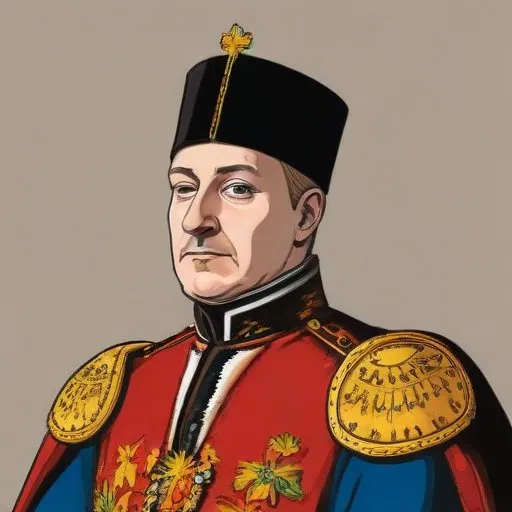
A 15th-century German nobleman who ruled Saxony and played a significant role in the Hussite Wars, known for his military campaigns and territorial expansions.
Known as Albert the Bold or Albert the Courageous, Albert III, Duke of Saxony, was a 15th-century leader who left an indelible mark on European history. As the founder of the Albertine line of the House of Wettin, he played a pivotal role in shaping the fate of Saxony and its people.
Born on January 27, 1443, in Grimma, Albert was the third and youngest son of Frederick II, the Gentle, Elector of Saxony, and Margarete of Austria, sister of Frederick III, Holy Roman Emperor. His family ties and upbringing would later influence his political and military pursuits.
After escaping from the clutches of Kunz von Kaufungen, who had abducted him along with his brother Ernest, Albert spent time at the court of Emperor Frederick III in Vienna. This experience likely instilled in him the importance of diplomacy and statecraft. In 1475, he took a prominent role in the campaign against Charles the Bold, Duke of Burgundy, showcasing his military prowess.
In 1464, Albert married Zdenka Sidonie, daughter of George of Podebrady, King of Bohemia, in Eger (Cheb). Although he failed to secure the Bohemian Crown upon George's death in 1471, this union demonstrated his efforts to forge strategic alliances.
Following the death of his father in 1464, Albert and his brother Ernest initially ruled their lands together. However, in 1485, the Treaty of Leipzig led to a division of territories, with Albert receiving Meissen and surrounding districts, thereby founding the Albertine branch of the House of Wettin.
Albert's reign was marked by conflicts with neighboring powers, including the Austrian-Hungarian War (1477-1488) with King Matthias Corvinus of Hungary. Despite setbacks, such as the failure of his 1487 expedition against Matthias, Albert remained a capable leader and strategist.
Albert III, Duke of Saxony, left behind a legacy of courage, diplomacy, and statecraft. His ability to navigate complex alliances and conflicts shaped the course of Saxony's history, ensuring the Albertine line's continued prominence. As a testament to his enduring impact, Albert remains an important figure in the annals of European history.
Through his remarkable life, Albert III, Duke of Saxony, demonstrated the qualities of a true leader, navigating the complexities of medieval politics and leaving a lasting impact on the region's history.
Born in 1529
Duke of Saxony who ruled from 1554 to 1566, known for his role in the Protestant Reformation and his involvement in the Council of Trent.
Born in 1670
A powerful Polish king who transformed his country into a major European power through military conquests and cultural achievements, earning him the nickname "the Strong".
Born in 1797
King of Saxony from 1836 to 1854, known for his efforts to modernize and industrialize his country, and for his role in the Revolutions of 1848.
