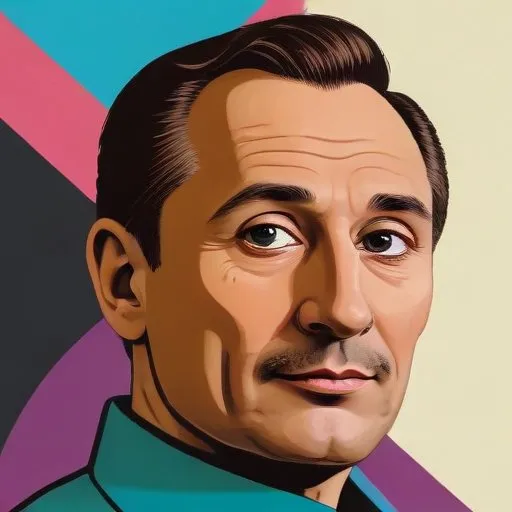
Alexander Liberman: The Visionary Artist and Editor
A Creative Force in Publishing and Art
Alexander Liberman was a Ukrainian-American magazine editor, publisher, painter, photographer, and sculptor who left an indelible mark on the art and publishing worlds. He is best known for his 32-year tenure at Condé Nast Publications, where he held senior artistic positions and played a crucial role in shaping the visual identity of some of the most iconic magazines of the 20th century.
Early Life and Career
Born on September 4, 1912, in Kyiv, Ukraine, Liberman was raised in a Jewish family that later moved to Moscow when his father took a post advising the Soviet government. When life became difficult in Moscow, Liberman's father secured permission from Lenin and the Politburo to take his son to London in 1921. This early exposure to different cultures and environments would later influence Liberman's eclectic and cosmopolitan approach to art and publishing.
Rise to Prominence in Publishing
Liberman began his publishing career in Paris in 1933-1936 with the early pictorial magazine
Vu, where he worked under Lucien Vogel as art director, then managing editor. He collaborated with renowned photographers such as Brassaï, André Kertész, and
Robert Capa, honing his skills and developing an eye for innovative visual storytelling. After emigrating to New York in 1941, Liberman joined Condé Nast Publications, where he rose to the position of editorial director, which he held from 1962 to 1994.
A Passion for Visual Arts
In the 1950s, Liberman discovered his passion for painting and later, metal sculpture. His highly recognizable sculptures, assembled from industrial objects such as steel I-beams, pipes, and drums, often painted in uniform bright colors, showcase his unique aesthetic. In a 1986 interview, Liberman said, "I think many works of art are screams, and I identify with screams." This philosophy is reflected in his massive work,
The Way, a 65-foot structure composed of 18 salvaged steel oil tanks, which has become a signature piece of Laumeier Sculpture Park in St. Louis, Missouri.
Photography and Capturing the Artistic Spirit
Before finding success in painting and sculpture, Liberman was an accomplished photographer. Beginning in 1948, he spent his summers visiting and photographing a generation of modern European artists in their studios, including
Georges Braque,
Henri Matisse,
Maurice Utrillo,
Marc Chagall, and
Marcel Duchamp. These photographs not only captured the essence of these artistic legends but also provided a unique glimpse into the creative process of some of the most influential artists of the 20th century.
Legacy and Impact
Alexander Liberman's legacy extends far beyond his individual achievements in publishing, painting, sculpture, and photography. He played a significant role in shaping the cultural and artistic landscape of the 20th century, inspiring generations of creatives and art enthusiasts alike. Through his work, Liberman continue
s to inspire and influence contemporary artists, publishers, and anyone who appreciates the intersection of art, design, and creativity.
Quotes and Wisdom
- "I think many works of art are screams, and I identify with screams." - Alexander Liberman (1986)
- "The most important thing in art is the thing that cannot be explained." - Alexander Liberman
Awards and Honors
- American Institute of Graphic Design (AIGA) Medal (1984)
- Inducted into the Art Directors Club Hall of Fame (1985)
Remembering Alexander Liberman
Alexander Liberman passed away on November 19, 1999, leaving behind a rich legacy of artistic innovation, editorial excellence, and a profound impact on modern society. His work continues to inspire and delight, serving as a testament to the power of creativity and the human spirit.
FAQ
What was Alexander Libermans role at Condé Nast?
Alexander Liberman was a Russian-American publisher, painter, photographer, and sculptor who served as the editorial director of Condé Nast publications for over 40 years.
What was Alexander Libermans approach to magazine publishing?
Liberman was known for his emphasis on visual storytelling and his ability to find and nurture new talent, which helped shape the aesthetic of Condé Nast publications.
What was Alexander Libermans experience like as a refugee in the United States?
Liberman emigrated to the United States in the 1940s, where he began his career in publishing, leveraging his European background to bring a new perspective to American magazines.
What was Alexander Libermans most notable work as an artist?
Liberman was a prolific artist who experimented with various mediums, including painting, sculpture, and photography, and his work has been exhibited in numerous galleries and museums.
What is Alexander Libermans legacy in magazine publishing?
Libermans influence on magazine publishing is still felt today, with his emphasis on visual storytelling and his ability to discover new talent continuing to shape the industry.