


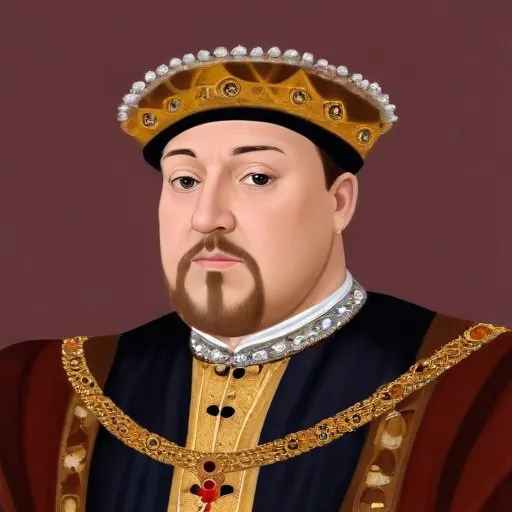
A trusted advisor and confidant to the infamous King Henry VIII, known for his influence in the royal court and involvement in the English Reformation.
As a member of the Reformist circle, Denny played a significant role in offsetting the conservative religious influence of Bishop Gardiner. This group of reform-minded individuals sought to bring about change and modernization to the Church of England, a movement that would have far-reaching consequences.
Born on January 16, 1501, Anthony Denny was the second son of Sir Edmund Denny, a Baron of the Exchequer. Educated at St. Paul's School and, according to tradition, St. John's College, Cambridge, Denny was well-equipped to navigate the complexities of court life.
His early career saw him serving as a servant to the courtier Francis Bryan, before joining the king's household in 1533 as a groom of the privy chamber. This position allowed him to build a rapport with the monarch, paving the way for his future appointments.
Anthony Denny's impact on modern society cannot be overstated. As a member of the Reformist circle, he played a crucial role in shaping the future of the Church of England. His influence extended beyond the religious sphere, as he was also a wealthy man, acquiring several manors and former religious sites distributed by the Court of Augmentations after the Dissolution of the Monasteries.
In 1547, he was elected knight of the shire MP for Hertfordshire, further cementing his position as a respected and influential figure in English politics.
Anthony Denny's life serves as a testament to the power of devotion and service. Through his unwavering dedication to King Henry VIII, he rose to prominence, earning the trust and respect of the monarch and the nation. As we reflect on his life, we are reminded of the enduring legacy of a man who left an indelible mark on the course of English history.
Born in 1491
A larger-than-life monarch who ruled England with an iron fist, infamous for his six marriages and the English Reformation.
Born in 1489
Leader of the English Reformation, instrumental in creating the Church of England and authoring the Book of Common Prayer.
Born in 1478
A renowned Renaissance humanist and statesman who served as Lord Chancellor of England, famous for his literary work "Utopia" and his martyrdom for refusing to acknowledge the English monarch's supremacy over the Church.
Born in 1485
Spanish princess who became the queen consort of England, playing a central role in the English Reformation and sparking the creation of the Church of England.
Born in 1284
The king whose disastrous reign led to his eventual deposition and mysterious death, remembered for his alleged homosexual relationships and power struggles with nobles.
Born in 1516
The first queen to rule England in her own right, Bloody Mary tried to restore Catholicism, earning her notorious reputation for burning hundreds of Protestants at the stake.
Born in 1533
The Virgin Queen, a powerful and beloved monarch, ruled England during a golden age of culture, literature, and exploration, establishing the Church of England and defeating the Spanish Armada.
Born in 1574
An English explorer and cartographer who mapped the New World and created innovative navigational tools, contributing significantly to the development of modern cartography.
