


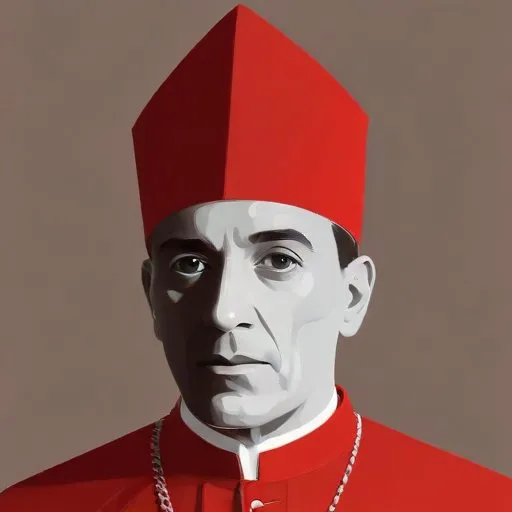
A 17th-century French Catholic cardinal who played a significant role in shaping the Church's policies and was a key advisor to King Louis XIV. He's most known for his diplomatic efforts and ecclesiastical reforms.
Antoine de Crqui Canaples was a renowned French Roman Catholic bishop and cardinal, distinguished for his remarkable ecclesiastical career, notable appointments, and significant contributions to the Catholic Church.
Born on July 17, 1531, in the Kingdom of France, Antoine de Crqui Canaples was the son of Jean de Crqui, seigneur of Canaples, and his wife Marie d'Acigné. Following the death of his two brothers, he inherited his family's vast wealth, which he later bequeathed to his sister's son, Antoine de Blanchefort, father of Charles de Blanchefort.
Crqui began his ecclesiastical career as a cleric in Throuanne and was designated Bishop of Throuanne in 1553, although he never occupied the see. He went on to become Chancellor of the Order of Saint Michael and a Knight of the Order of the Holy Spirit, as well as the Provost of the Premonstratensian Slincourt Abbey.
In 1552, Henry II of France nominated him to be Bishop of Nantes, and the cathedral chapter of Nantes Cathedral elected him to the position on December 15, 1553. He was ordained as a priest on April 22, 1554, and consecrated as a bishop later that afternoon.
On July 14, 1564, Crqui was transferred to the Diocese of Amiens, exchanging his see with Cardinal Nicolas de Pellevé. He became a member of the French Conseil d'État under Charles IX of France and was elevated to the position of cardinal deacon in the consistory of March 12, 1565, by Pope Pius IV.
Crqui received the red hat and the titular church of San Trifonio on March 13, 1566. Although he did not participate in the papal conclave of 1565-1566 that elected Pope Pius V or the papal conclave of 1572 that elected Pope Gregory XIII, his influence in the Catholic Church was undeniable.
Antoine de Crqui Canaples passed away on June 20, 1574, in Amiens. According to his will, he received heart burial, with his body being buried in the Benedictine Moreuil Abbey and his heart buried in Amiens Cathedral.
Throughout his remarkable career, Crqui left an indelible mark on the Catholic Church, demonstrating unwavering dedication and commitment to his faith. His legacy continues to inspire generations, serving as a testament to his enduring impact on the ecclesiastical world.
Born in 1619
A 17th-century mastermind who centralized France's economy, creating a powerful and efficient financial system that fueled the country's growth and prosperity. He's renowned for his innovative economic policies and reforms.
Born in 1627
A 17th-century French bishop and theologian who wrote influential works on theology, politics, and history, shaping the Catholic Church's stance on various issues. He's also known for his eloquent sermons and funeral orations.
Born in 1613
A 17th-century French nobleman and writer, known for his witty and insightful maxims that offer profound commentary on human nature and morality. His writings continue to influence literature and philosophy to this day.
Born in 1639
A 17th-century master of French tragedy, crafting intricate, psychologically complex dramas that probed the human condition, influencing the development of Western theatre.
Born in 1622
A 17th-century master of comedy, he penned witty plays that satirized the French aristocracy, leaving a lasting impact on Western theater. His works remain widely performed and adapted today.
Born in 1623
A 17th-century genius who made major contributions to mathematics, physics, and philosophy, inventing the mechanical calculator and developing the theory of probability. His writings also explored the human condition and faith.
