


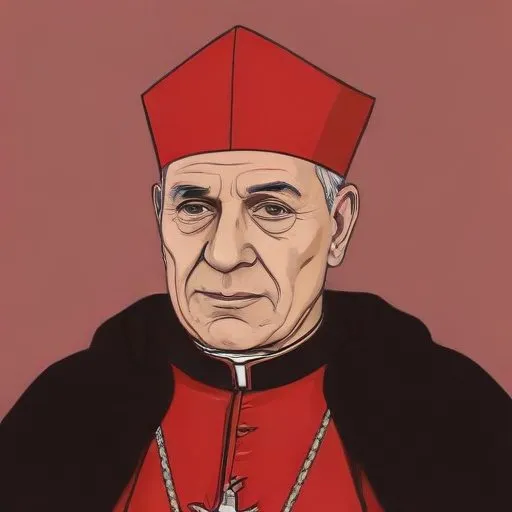
A 16th-century Roman Catholic cardinal who played a key role in the Council of Trent, reforming the Church and shaping Catholic doctrine. He was a skilled diplomat and strategist, influencing major ecclesiastical decisions.
Antonio Trivulzio, seniore, also known as the Cardinal of Como, was a prominent Italian Roman Catholic bishop and cardinal who left an indelible mark on the ecclesiastical and political landscape of 15th-century Italy. Born in Milan in 1457, Trivulzio was a member of a noble family and was destined for greatness, eventually rising to become one of the most powerful and respected figures of his time.
Trivulzio was born into a family of Milanese patricians, with his father, Pietro Trivulzio, and mother, Laura Bossi, instilling in him a strong sense of morality and ambition. He obtained a doctorate in law and went on to join the Canons Regular at Sant'Antonio in Milan, where he was ordained as a priest.
Trivulzio's exceptional abilities and diplomatic skills soon caught the attention of the powerful Duke of Milan, Gian Galeazzo Sforza, who appointed him to his privy council. This marked the beginning of Trivulzio's rapid ascent, as he went on to serve as ambassador to Parma and Rome, and eventually became the Bishop of Como in 1487, a position he held until his death.
In 1500, Trivulzio was elevated to the rank of Cardinal Priest by Pope Alexander VI, and received the titular church of the Basilica di Sant'Anastasia al Palatino. As a cardinal, Trivulzio played a key role in shaping the papacy, participating in two papal conclaves that elected Pope Pius III and Pope Julius II. He also served as Camerlengo of the Sacred College of Cardinals from 1505 to 1506.
Trivulzio's diplomatic prowess was unmatched, as he navigated the treacherous landscape of Italian politics with ease. He allied himself with Louis XII of France, and in 1499, became one of the regents of Milan following the downfall of Ludovico Sforza. He also served as dean of the cathedral chapter of St. Donatian's Cathedral in Bruges, a testament to his far-reaching influence.
Antonio Trivulzio, seniore, left a lasting legacy, not only in the realm of ecclesiastical politics but also in the cultural and artistic landscape of Italy. His commitment to education and the arts was unparalleled, and his influence can be seen in the many architectural and artistic projects he sponsored during his lifetime. Despite his many accomplishments, Trivulzio remained humble and devoted to his faith, earning the respect and admiration of his contemporaries.
Antonio Trivulzio, seniore, was a true Renaissance man, whose remarkable life and career serve as a testament to the power of ambition, diplomacy, and devotion. His legacy continues to inspire and captivate, offering a glimpse into the complex and fascinating world of 15th-century Italy.
Born in 1536
Led the Catholic Church during a tumultuous period, issuing papal bulls and playing a key role in the Counter-Reformation. He's also famous for his coffee habit, being the first Pope to try and approve of it.
Born in 1535
The second shortest-reigning pope in history, serving for just 27 days in 1605, he is most known for his brief but tumultuous papacy marked by power struggles and controversy.
Born in 1476
A fierce defender of Catholic orthodoxy, he implemented strict reforms and established the Roman Inquisition to root out heresy. His papacy was marked by controversy and conflict.
Born in 1568
The 17th-century Catholic leader who reigned for 21 years, known for his strong stance against Galileo Galilei and his scientific discoveries, as well as his extensive patronage of the arts.
Born in 1611
Led the Catholic Church during a tumultuous period, reforming the Church's finances and combating corruption, while also opposing the French monarch's attempts to exert control over the Church.
Born in 1431
Ruthless and cunning, this Pope was infamous for his corrupt and immoral ways, using his power to further his family's interests.
Born in 1590
The 254th Pope, a strong advocate for the Catholic Church's authority, known for his papal bull condemning the doctrine of probabilism.
Born in 1611
Led the Catholic Church during a tumultuous period, reforming the Church's finances and combating corruption, while also opposing the French monarch's attempts to exert control over the Church.
