


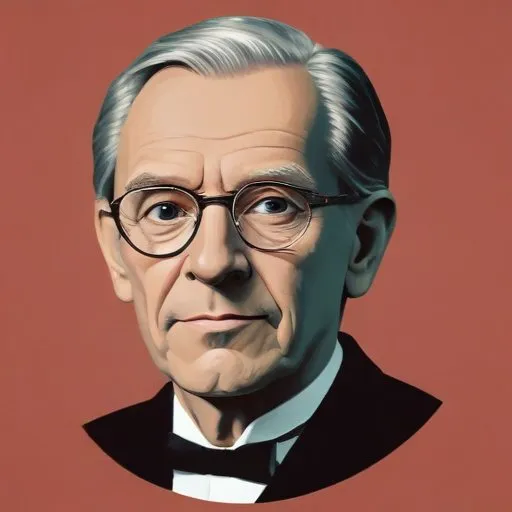
A Swedish biochemist and academic who pioneered protein separation and purification techniques, earning a Nobel Prize in Chemistry in 1948.
Arne Tiselius, a renowned Swedish biochemist, left an indelible mark on the scientific community with his groundbreaking research on electrophoresis and adsorption analysis. His pioneering work on serum proteins earned him the Nobel Prize in Chemistry in 1948, solidifying his position as a leading figure in the field.
Born on August 10, 1902, in Stockholm, Sweden, Tiselius's early life was marked by a change in scenery when his family moved to Gothenburg following his father's passing. He attended the local Realgymnasium, graduating in 1921, before pursuing higher education at Uppsala University, where he developed a passion for chemistry.
Tiselius's academic trajectory was punctuated by significant milestones. In 1925, he became a research assistant at Theodor Svedberg's laboratory, earning his doctoral degree in 1930 with a thesis on the moving-boundary method of studying protein electrophoresis. His subsequent papers on diffusion and adsorption in naturally occurring base-exchanging zeolites further solidified his expertise.
A Rockefeller Foundation fellowship supported his year-long visit to Hugh Stott Taylor's laboratory at Princeton University, where he continued his research on proteins and physical methods in biochemistry. Upon his return to Uppsala, Tiselius refined his electrophoretic analysis method, laying the groundwork for future breakthroughs.
Tiselius played a crucial role in reorganizing scientific research in Sweden following World War II. He served as President of the International Union of Pure and Applied Chemistry (1951-1955) and Chairman of the Board for the Nobel Foundation (1960-1964). His influence extended beyond the scientific community, leaving a lasting impact on modern society.
"We live in a world where unfortunately the distinction between true and false appears to become increasingly blurred by manipulation of facts, by exploitation of uncritical minds, and by the pollution of the language." - Arne Tiselius
Tiselius's contributions to the field of biochemistry paved the way for future generations of scientists. His meticulous research and innovative methods continue to inspire scientific inquiry, ensuring his legacy as a pioneer in the world of serum proteins and beyond.
Born in 1859
A Nobel Prize-winning physicist and chemist who pioneered the understanding of acid-base chemistry and greenhouse gases, laying the foundation for modern climate science.
Born in 1873
A Nobel Prize-winning biochemist who discovered the co-enzyme Q and its importance in cellular respiration, making significant contributions to our understanding of cellular energy production.
Born in 1905
A Swedish physiologist and academic who discovered neurotransmitters, specifically noradrenaline, and its role in the nervous system, earning him a Nobel Prize in Physiology or Medicine in 1970.
Born in 1924
A Swedish neurophysiologist and academic who discovered the organization and function of the visual cortex, and was awarded the Nobel Prize in Physiology or Medicine in 1981 for his work on the brain's visual system.
Born in 1900
A Finnish-Swedish physiologist who discovered the workings of the retina and developed the concept of receptive fields, earning him the Nobel Prize in Physiology or Medicine in 1967. His work laid the foundation for modern neuroscience and visual perception research.
Born in 1885
A Hungarian-German chemist and academic who discovered and named the elements hafnium and protactinium, and was awarded the Nobel Prize in Chemistry in 1943 for his work on radioactive isotopes.
Born in 1868
Developed a process to synthesize ammonia, revolutionizing agriculture and warfare, and was awarded the Nobel Prize in Chemistry in 1918.
Born in 1881
Discovered penicillin, a revolutionary antibiotic, and pioneered its use in medicine. This breakthrough has saved countless lives and transformed the field of healthcare.
